Search This Blog

Showing posts with label earwigs. Show all posts

Saturday, November 13, 2010

Green Lynx Egg Sac Notes


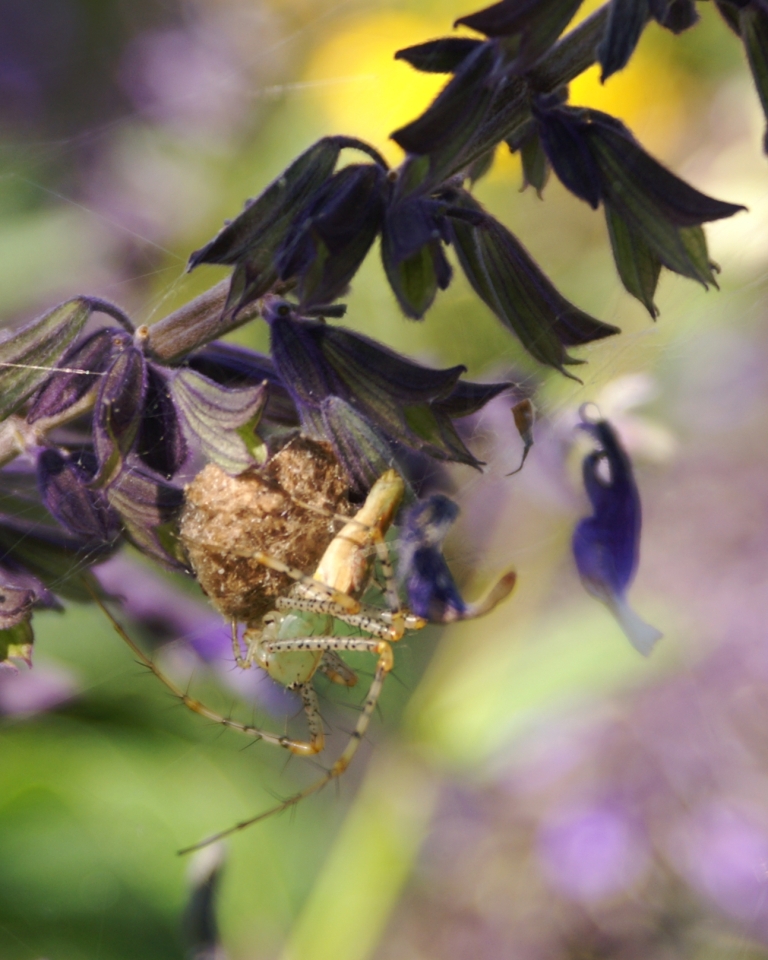
The lynx spider (Peucetia viridans) with the season's 1st egg sac, seen here, has moved her sac from place to place.  Initially she was located in the African basil, then she moved to a flower spike of Salvia 'Indigo Spires'.


Recently she's been sunning on a leaf of Salvia 'Waverly' with the pale pink flowers and name I can never remember except by using the reference 'Wire-ly' which describes this plant's habit as it doesn't quite get enough sun in my yard and stretches through the fence for support.  Anyway, these lynx spider moms do move the egg sac around for whatever reasons: to get out of the rain, to sun themselves and/or the eggs, to get to a better hunting spot, maybe to get away from potential egg predators; I dunno, do spiders get bored?

This morning this spider (Egg sac #1) was having an earwig meal while standing guard over her egg sac in the sun.

I noticed another green lynx egg sac recently because it's bright yellow color caught my eye.  This female had recently set up in the top of a large old lavender bush on the south side of the house and I assume the egg sac was quite freshly created at the time I first saw it.  I wondered about the egg sac color, since every other one I've seen is whitish or tan/straw colored.  I'm thinking it's possible that pollen from the acacia iteaphylla (about 10 feet away) that is in full bloom has gotten incorporated into the egg sac silk and caused the yellow color.  Hanging in the lavender is a bit of acacia flower fluff and you can see the similarity in color.   


Here is a cluster of A. iteaphylla blossoms for your viewing pleasure.


After a couple days, Yellow sac is still in approximately although not exactly the same spot on the lavender, and her egg sac has faded to olive greenish.

Sunday, June 14, 2009

June Gloom-buster Blooms


June 15 bloom day.
In spite of weeks going by without measurable sunshine, still there are flowers and bugs. It's a good thing there are because we southern Californians need all the cheering up we can get to avert S.A.D., not to mention having to tolerate Schwartzenegger, the state going broke, the water shortage and incipient threats from Pyongyang. People in the north (of our great state, that is) have the same dismal conditions to endure but they are adapted to living without sunshine for long stretches. We just aren't used to suffering without sunshine!


The aloe brevifolia is in full bloom and its bright orange is a glad sight to humans and bugs alike. Wondering whether earwigs can discern color, why one would climb 2.5 to 3 feet up a stalk to hide its head inside a flower; trying to understand what exactly boatman flies are doing with their wing-waggles; analyzing the cost to benefit ratio of lily family inflorescences are just a few of the many conundrums and mysteries that abound within the everyday garden to keep one's mind off of the gloom of June 2009. Flowers + Bugs = Happiness.

Saturday, April 25, 2009

Earwigs Can Become Pesky


In spring I have trouble with earwigs devouring small transplants and damaging flowers. They get active after sundown and climb surprisingly high up into your plants in search of delicacies to feed on, including aphids. (This further supports my notion that aphids are just plant juice transmogrified, and eating aphids does not change the eater's status as an herbivore.)

Here is a European earwig, Forficula auricularia, holed up in a flower five feet up on a climbing rose on a cloudy day. They like dark and dampness and you can use that information to control the buildup of their numbers to damaging levels. Remove as much as possible places for them to hide in the garden and lay eggs such as boards, overturned pottery, clipped vegetation you didn't get around to cleaning up, etc. Then you can set traps consisting of a nice dark cozy spot (a piece of hose, a rolled up newspaper, a board, an overturned pot) in chosen spots near plants the buggies may be damaging. Check your traps each day; knock off the earwigs you find into a plastic bag or vessel of water and (gulp) destroy them. Soon the number of earwigs in the traps will diminish, indicating the population has been significantly reduced, probably below problem levels.

Reference: UC IPM pest note on earwigs.