Search This Blog

Showing posts with label politics. Show all posts

Tuesday, November 06, 2012

Election Bug Fun

From our own LA Times:

If Romney wins, statistician will eat bug.

http://www.latimes.com/news/opinion/opinion-la/la-ol-campaign-promises-20121106,0,5492503.story

If this was your wager, what bug would you think of eating?  For my part not so sure on the green stink bug pictured (picturesquely) with the story.

Green Shield Bug


I'm thinking something smaller, less leggy and less smelly.  Like a silverfish.  Or a springtail.  Small.

Anyway, it's just past 7pm pacific time; it doesn't look like Mr. Wang is in danger of getting Nezara leg fragments stuck in his teeth.  I'm saying this between clenched teeth.

UPDATE:  9:20pm pacific time.  Lookin' like no bug eating will be required.  I repeat:  No Bug Eating Will Be Required!

Yeah, Cindy.  Ice cream, or maybe frozen yogurt.  Yay for frozen desserts!

Saturday, October 15, 2011

Some Flowers for October: part 1


I shambled into the backyard this morning, my mind in a bit of a fog thinking about corporate greed and all the bad that comes with it, when I noticed a stench of dead animal.  Seriously, I was mincing my steps as I scoped out the vegetation for buggies and stuff, imagining my foot's encounter with a possible half-rotten carcass lurking under a dried-up fallen-over corn stalk or an overgrown buckwheat or something.

Then I remembered: it was the sweet smell of stapelia in bloom.  This spring I divided my big old potted clump of stapelia gigantea, aka carrion flower, creating many more smaller plants.  This succulent plant, a member of the milkweed clan, is ridiculously easy to grow and propagate.  But once propagated bloom they will . . . beware the stench.  One of the cuttings shown here with a big balloon-like bud and a withered up claw of a spent flower.

Flies are attracted by the smell and meat-like appearance of the flowers, and they actually lay eggs on the flowers which hatch, live for a few days, then die of hunger.  The top photo shows a beetle of some unidentified sort that was also attracted to the flower.  Here's a fly and the beetle.  More about flies and stapelia here.

Tuesday, November 02, 2010

Post-Halloween Election Weigh In


Halloween has passed and it's time to size up the haul.  It's enough to make a cranky pumpkin reach for a beer, but there's no time for drinking now, with the polls closing in just a few hours.

If you believe the talking heads (and keyboards) This Election is Interestingly Different.  I knew something was up when my post office box kept being filled with odd-sized glossy coverstock mailers.  Sometime in October I started saving this stuff out of curiosity, and thinking I would look it over as I sat down on election day for my traditional filling out of the sample ballot over lunch.  So, yeah, sadly some of the mailers got thrown away before they were counted and weighed in.

Nevertheless:  we ended up with 72 pieces altogether, at a total weight of just over 2.5 pounds.  That may not sound like too much, but remember we have the economy sized post office box.  Twenty of these pieces were concerning the gubernatorial race, at a total weight of 15 ounces.  This makes sense, since the governor is an important position and it is reasonable that these mailers would be 34% weightier than average.  We're a smallish town, Tustin, but we have 8 folks running for city council.  From them we received 16 mailers weighing 10 ounces, not counting the stuff we were handed at our local city fair in early October.  That's 12% above average but respectfully less than the material from the governor-hopefuls.  Everything else, from legalizing pot through candidates for school board and redistricting initiatives, made up the balance including those slate mailers from the firefighters, tax-savers, dog-lovers, etc etc. 

I must say, some of the most useful information in these mailers are the endorsements.  If a city councilperson I can't abide endorses a candidate, well, that candidate can't be all good, can they?  Other tidbits I enjoyed were the smear attempts in our local races none of which could be verified by the sources the authors offered on their mailer.  Beth Krom, candidate for US Congress, gets the nod for most entertaining and varied mailers, including the one with the OC/DC graphic prominently featured in my photo. 

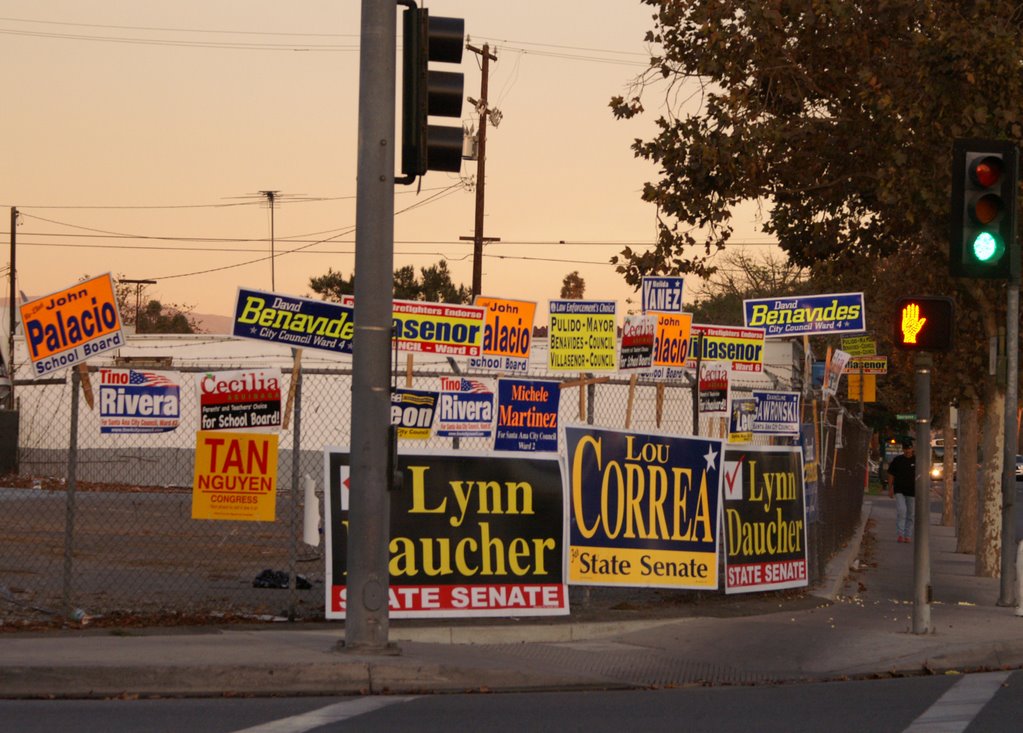
This stuff, along with the obligatory campaign signs scattered along the road is colorful now, but soon will fade, dry up and blow away like so many autumn leaves.  That is, unless their owners come along tomorrow and pick them all up.

Fave election sign spotted on a cul de sac near my home; a call for humor and proper sequencing of holidays:

Sunday, June 14, 2009

June Gloom-buster Blooms


June 15 bloom day.
In spite of weeks going by without measurable sunshine, still there are flowers and bugs. It's a good thing there are because we southern Californians need all the cheering up we can get to avert S.A.D., not to mention having to tolerate Schwartzenegger, the state going broke, the water shortage and incipient threats from Pyongyang. People in the north (of our great state, that is) have the same dismal conditions to endure but they are adapted to living without sunshine for long stretches. We just aren't used to suffering without sunshine!


The aloe brevifolia is in full bloom and its bright orange is a glad sight to humans and bugs alike. Wondering whether earwigs can discern color, why one would climb 2.5 to 3 feet up a stalk to hide its head inside a flower; trying to understand what exactly boatman flies are doing with their wing-waggles; analyzing the cost to benefit ratio of lily family inflorescences are just a few of the many conundrums and mysteries that abound within the everyday garden to keep one's mind off of the gloom of June 2009. Flowers + Bugs = Happiness.

Tuesday, January 20, 2009

My Pineapple Story Jan 20 2009


Three and a half years ago I twisted the top off a pineapple and stuck it in a jar of water on the kitchen windowsill as an act of gardener’s optimism. It might grow, I thought, and to a gardener growth—the act of taking carbon from the air and turning it into pineapple tissue by the power of sunlight—is the thing. The idea of pineapple fruit was not, at this point, part of this small act of horticulture, this simple desire to witness the alchemy of growth.

August 2005, when my pineapple plant started its journey, was a low point in American history. I have never felt more frustrated to be an American than I did that summer when the great city of New Orleans suffered and we watched in effete horror and our president ended his record-breaking summer vacation.

The thing grew roots, and soon after being potted in soil, grew a strong healthy crown of leaves. It was repotted and moved to a better spot in the garden as months passed and the plant grew larger and older.

Months passed and little happened in the big world outside my garden to evidence that we had competent leadership or governance in our country. In fact it seemed like we were adrift, our minds numbed by one incomprehensible decision following another, and science, civility, nor unified planning nowhere to be found in the public discourses it seemed. Out of this void, as my little pineapple grew, people once cowed by official admonitions to “watch what you do, watch what you say” were finally stepping out into the light and growing some vocal chords, it seemed.

If I had researched pineapple culture in advance, I might have begun to anticipate in spring of 2008 a bloom. I just let nature and ignorance take its course, and as a surprise to my uninformed self, a fine flower spike arose from the plant in early August 2008.

About the time my stimulus check was absorbed and all but buried in the morass of bad bad news about the economy, about the time the pineapple flower emerged, about then a leader was winnowed from the chaff of other would-be leaders and seemed to have the tone people were looking for, to hang their hopes upon; about then an Alaskan moose hunter appeared and momentarily threatened to shoot down hopes of pineapple fruit.

After the inflorescence appeared, I read up on what to expect, in retrospect, from a pineapple top. Sunset Western Garden Book, usually impeccably correct, felt my plant had bloomed a year late, but according to Don’t Throw It, Grow It! (Peterson & Selsam , Storey Publishing, 2008) the flower spike appeared right on schedule: “When the plant is about 3 years old, it is ready to bloom.” ! I also found that everyone agrees it takes about 6 months for the fruit to grow and ripen after the bloom appears so as the 5 month milestone passed and the fruit began to turn golden, I felt confident in my plan to harvest it toward the end of January.


Americans rejected fear and elected Obama a
gainst my darkest fears of another election day shock and we started to feel good about ourselves again.

I cut my fine fruit from the stem late in the day on a sunny Jan 19 capturing a full day’s sun inside its fleshy corpus. On Jan 20 we ate the pineapple of my non-labor, the fruit of the sun and a bit of water, the fruit of a gardener’s optimism and spirit of adventure, the fruit of goodwill and patience, of listening to a bit, even if post-floriferously, of the advice of others.


The president of the united states said that we must pick ourselves up, dust ourselves off and grow pineapples in his speech this morning; and I know that we can grow pineapple and my pineapple is a symbol of the work that must be done with a spirit of optimism, openness and goodwill, to restore the American garden, metaphorically.

I have placed the twisted-off top of my pineapple in a small jar of water. I have expectations for its fruit in about 3.5 years.

The president remarked today that, among many other tasks, we will restore science to its rightful place.

Gardening is a pursuit that relies on science; the knowledge from others who have preceded us in growing things saves time, effort, resources, frustration, and the lives of many plants in the course of developing a garden. In today’s hungry world our gardens and farms need all the science we can get to grow enough food for all without further degrading the atmosphere and so I’m happy to have leadership that embraces that need. We also need small-science (post-modern folklore?) to nurture the necessary senses of wonder, optimism and expectation for success common among people who would garden, to keep in front of our noses the demonstration of how nature works to make food, in case we tend to forget. Gardens nurture wild experimentation with oddball plants picked up at yard sales, inappropriately labeled things that grow well but larger than expected, volunteer plants blown or pooped in that end up supporting local wildlife, or volunteers seeded from existing garden plants slowly selecting themselves for a better-adapted life in that particular spot on earth; and the culture of leftovers and clippings, little bits of plant tissue with the capacity to grow. This is a friendly world; we have every right to expect things to grow given a bit of craft.

Pineapple (Ananas comosus) is a bromeliad, in fact the commander and chief bromeliad of the Pineapple Family. The plant utilizes CAM photosynthesis, gathering and fixing carbon at night and closing its stomata during daylight. This conserves water that would have been transpired while the sun shone, making the pineapple plant more drought tolerant. Sometimes you see a seed in a pineapple fruit; the flowers are mostly pollinated by hummingbirds. My fruit had one small black seed in it, suggesting that a hummingbird visited and also that a pineapple can self-fertilize. I forgot to count the spirals on my fruit, but there are supposed to be 8 spirals one way and 13 the other on every pineapple fruit.


# # #
A hurricane is a mixed drink featuring rum, rum, rum and pineapple juice. Mix yourself one and toast the beginning of life as we know it.

Friday, November 14, 2008

Use Only As Directed, preferably with meals


This are flowers of stevia rebaudiana past their prime and going to seed. Stevia is also known as sweetleaf, and is used as a sweetener both in its natural form and in a processed extract of the sweet glycosides steviodside and rebaudioside. The fresh leaves are slightly fuzzy, and taste exceptionally sweet when chewed, with an undertone of something green or slightly bitter. Some people describe this aftertaste as licorice. I notice the larger leaves are sweeter tasting than the smallest. Stevia is a pleasantly unassuming perennial with smallish white flowers and an upright habit. Who knew that controversy and conspiracy theories swirled around it.

The 1.3 ounce jar of stevia extract powder I own has lasted us a long time. It comes with a tiny spoon not quite as large as your pinky fingernail. Even one spoonful makes my tea too sweet, and being mainly a coffee-no sugar drinker you can see why we use so little of the stuff. We tried it because we were intrigued by a natural sweetening product with no calories, no carbs and no effect on blood sugar. I kept wondering why stevia hasn't taken the sweetener world by storm. This article gives an overview of the 1991 FDA ban on sales of stevia as a food. So that's why my jar of stevia is labeled as a dietary supplement, and gives the direction: "As a dietary supplement, take 1 to 3 servings daily, preferably with meals." Reading further, I discover Big Food companies Coca Cola, Pepsico and Cargill are now rolling out stevia products which aren't even pure stevia and skip some of stevia's benefits. Could the 1991 FDA ban have been the result of a few well-placed phone calls or contributions in favor of marginalizing a potentially devastating competitor to sugar and fake sugar laden sodas until the Big Boys were ready to reap the stevia harvest? Kind of like all those 30+ mpg cars we had in the 70s just went away.

Anyhoot, you'll find stevia plants in the herb section (I got this one at (ahem) Roger's Gardens) in small inexpensive pots. It seems to like regular water; mine grows in a pot in mostly shade and seems happy enough, having reached 24" tall in a few months. Probably would grow larger in full sun.

Wednesday, November 12, 2008

Midweek Mysteries on Myrtle


As a respite from wondering when the last of the erstwhile city council, Yes on 8, and sad Nader/Gonzales signs, left up for Veterans Day out of respect no doubt, will be removed from my surrounds, I had a look around the yard. I found two more unanswered questions there.

Both of these enigmas were found on the underside of myrtus communis leaves. This first image appears to be a parasitic wasp, a braconid, emerging from an egg it has parasitized. But on a second look the egg cluster really looks like a very tiny Polistes wasp nest or even waxy like honeycomb.

The second image is again what appears to be an egg mass. It was quite hard, not sticky or gooey, like a crust or lime deposit. Emerging from the "eggs" however are winged white somethings. If you know anything about insects you'll realize only adults have wings, and adults do not emerge from eggs (unless they are eggs of another species, parasitized). The shape of the buggies is really familiar to me but I am mystified, bamboozled and just cannot place what I am looking at here.

Monday, September 15, 2008

Saturday, September 06, 2008

The Sharpshooter Phenomenon


You might interpret the title of this post as a shameless attempt to cash in on the Palin buzz and trick unaware completely-not-interested-in-bugs web surfers into reading my blog, but you'd be wrong. This post has nothing to do with moose, the NRA, teen pregnancy, earmarks or anything at all (known or more likely unknown) about that female candidate for vice president of the United States. I am a woman, though, hoping you'll just continue reading out of some sense of misplaced enthusiasm!

This post is about that pesky bug Homalodisca vitripennis referred to by the common folk as the glassy-winged sharpshooter, is a leafhopper in the leafhopper (Cicadellidae) family with strong leafhopper family values. In the ornamental garden these bugs usually do little damage and they are sort of cute in a homely way. Their non-threatening appearance disguises their potential to wreak great damage, since they are a carrier of a bacterial disease of plants. The sharpshooter sucks the juice out of a broad range of plants by inserting its mouthparts into the fluid-conducting xylem. While it's sucking, if it is harboring xylella fastidiosa bacteria on its mouthparts the disease organism can be transmitted to a new host plant. This organism causes Pierce's disease which could wipe out life as we know it here in California: that is, it kills grape vines at the base of our wine industry. It also kills nerium oleander, a nice evergreen shrub that we have learned to live without but miss dearly.

This summer I've seen more sharpshooters than has been typical, but I've also noticed them on more plant hosts than before. These opportunistic little buggers have been feeding on sunflower, abutilon, privet, citrus, artemisia, texas ranger, pittosporum, dodonaea, asclepias, elm, broom corn, senecio, acacia, pseuderanthemum, and even opuntia. Cindy has quite a gathering on a fern in her yard. They are expanding their feeding host base.

What about their egg-laying hosts? I've found egg masses on privet, dodonaea, the kumquat and broom corn. The eggs are inserted beneath the epidermis on the underside of leaves, and so can be hard to spot on thicker leaves especially. So, of course there could be egg-laying on other species of plants that I just haven't seen.

Some parasites are beginning to take hold within the sharpshooter range, including my yard. Tiny wasps in the genus gonatocerus lay their own eggs on those of the sharpshooters, which then hatch, parasitize and kill the host. I've photographed some egg masses to show the difference between a parasitized mass and one that hatched sharpshooter nymphs. The first photo is a parasitized egg mass, and shows the characteristic pinholes which are the exit holes of the emerging wasps. Lots of the egg masses I am seeing had pinholes, and this is the first year I've seen them. The second photo down is a dried up egg mass that hatched. You can see there are no pinholes. The third photo is a dodonaea leaf that was heavily used for egg laying, where the dead portions have dried up and fallen out. No way to tell if they had or had not been parasitized. I haven't actually seen the wasps; the photos and information at UC IPM are consistent with my observations and so I believe these are indeed the wasps at work.


So the sharpshooter population has increased and spread out, but their parasites has also begun to take hold in the little domain of my yard. Evidence of pest-controlling parasites such as these gonatocerus wasps is a compelling reason NOT to use insecticides in my garden and yours since the sprays kill the wasps as well as they might the target pest. By the way, there are also lots of leafhopper assassin bugs hatching recently, which prey on the sharpshooters. Its been my experience that parasites and predators are more effective at pest control than spray over the longer term, and it will be interesting to see how the glassy-winged sharpshooter population moves next summer. Perhaps homalodisca vitripennis is on the verge of control and the IPMers will be able to chalk up another biocontrol victory.

And why are they called sharpshooters? After they insert their mouthparts into the xylem stream the volume of fluid is such that they must excrete in order to allow more plant juice in. So they shoot the shit so to speak in order to keep feeding. You'll be standing unawares in the yard enjoying the day or looking for bugs or thinking about which presidential candidate to vote for when all of a sudden a droplet or perhaps several droplets of excreta hit you in the face. I don't know about you but I tend to go for the guy with the most science and the least excreta.

Sunday, June 15, 2008

Salmon, pelargoniums and the Spread of Ich


I was reading a sad story in the LA Times today about salmon fisherpeople in Alaska and the trouble with ich. It seems the parasite Ichthyophonus hoferi has spread into the wild salmon population, infecting many of the fish and rendering them inedible or dead, due to the warming of the river water where the salmon spawn. You probably are familiar with this disease--known as Ich--if you've ever had aquarium fish. It seems to be a classic case of the spread of an organism into its prime niche as climate change is suspected of warming waters further north. In a similar way we in southern California find insect pests that used to be discouraged by our sorta cold winters and occasional frosts surviving the winter and building up harmful population levels. A great example of this was the spread of giant whitefly from Mexico through southern California from 1992 on. In fact, the population of giant whitefly has settled down to manageable levels for the most part as natural predators have adapted to use them as a resource (e.g. eat them); but for some they are still the scourge of hibiscus.

I noticed this helicoverpa caterpillar on the salmon-colored geranium, two years to the day from this post. Hardly significant since corn earworms can be found at many times during the year on this particular plant. Some people doubt the value of amateur observations of natural science since we, as amateurs, mostly aren't formally trained and might make a bad (or worse--redundant!) identification or observation of behavior. On the other hand, we have eyes in places where no professional naturalists are and might find something important. The Times story reports that back in the late 1980s a fisherman noticed something odd about the salmon and sent samples to be tested. He was brushed off. It wasn't until 2000 that any serious research started. Today, they are testing theories as to the extent of the disease and its effect on the salmon populations, and whether anything can be done to lessen the damage. Maybe if that fisherman had been taken seriously, or if there was a mechanism for observations of that sort to be disseminated to the scientific community, it wouldn't take 2 decades for meaningful research to happen.

I still don't like these salmon flowers, and I've never enjoyed eating salmon but I do think citizen science is good.

Tuesday, April 29, 2008

Domestic perfection


I found this spider shed--perfect in every joint and leg segment--in the drawer where I usually keep the dog brush. Maybe that reveals how seldom I/we groom the dog; or that I often forget to put the brush back where it belongs? Anyway, I set the exoskeleton into a green plastic bowl at the moment so it wouldn't get lost (or worse, broken), then kind of forgot about it. Here it is, proof that we do indeed produce something--spider skins!--in America.

What does the gardener/bug-nut who has everything (a magic tree that attracts hordes of butterflies, a nifty aerial collecting net, a day-glo orange fly swatter, a skein of green hemp twine and a smaller wad of purple, bottle gourd seeds, 1/2 price terracotta cactus bowls, a pretty OK camera, a shining black beetle climbing my elm tree, and a perfect spider skin) spend her tax rebate $$ on? Since in addition to all of the above I already have a cheap plastic collecting bowl from China?

Tuesday, February 05, 2008

It's Super Duper Tuesday


This snail, carrying its broken but regenerating shell like a hand-lettered picket sign, cruised boldly across the porch as a reminder to anyone paying attention that what has been hurt can be healed, what has been torn in pieces can be put together, what was dysfunctional can be imagined into something better, what was crushed can be built up again, even by a mollusk (given enough available calcium).

If you haven't already done so, read up on the candidates and issues and VOTE, dammit.

And have a super Tuesday.


Thanks to Cindy and her series on the healing process of snail shells.

Much later on, same day:

So I volunteered to work the polls this election. My curiousity and a sense of duty led me to do it. I had my lunch packed the night before; my carefully selected non-partisan outfit laid out, too, so there was no reason to wake up at 4:30 am except I was too nervous to sleep. It turned out to
be a crazy, aggravating, encouraging, pathetic, fun and funny experience. It has made me more than I was before; it has in a way helped begin to mend my broken shell.

Tuesday, October 30, 2007

Doing Our Civic Duty

So I was walking down my street to the post office and I noticed the fire hydrant in front of the abandoned Econo Lube n Tune was still festooned with brown widow egg cases. This building has been an eyesore in our neighborhood as long as I have lived here but recently has gotten worse because it is unoccupied as well as unmaintained. The boldness of this spider says to me she has no fear of being messed with since no one has passed her way with a rake, a broom, or a leaf blower since before she was born. We have noticed a population explosion of these spiders in the neighborhood, and I suspect plenty of them are harboring within the dark recesses of the abandoned garage. Even I, the spider-tolerater-if-not-lover, think too many of these venomous Latrodectus geometricus can't be a good thing. I think I shall complain to the city, and perhaps they will turn the thing into a neighborhood arts and crafts workshop. Ha. Or at the very least an ice cream shop. Ha ha.

So I walk past the hydrant and on the other side of it is the spider busily sucking the juices out of a rather large roach. And I thought, well, it goes to show you never can tell who is the bad guy. Thank you, L. geometricus for one less cockroach on the street. Meanwhile, this image of the roach (ever the symbol of urban decline) being consumed by a deadly spider perched on a piece of city infrastructure will certainly add pith to my plea to the city to develop a pocket park, if not a community garden, on the site of the crumbling garage.

Monday, October 15, 2007

Environmental Action/Take one


This is a dumb little story of a trivial thing that happened in my unimportant neighborhood on October 12, still remembered by oldsters like myself as the day Christopher Columbus' expedition made landfall in the Caribbean and formerly celebrated in the US as Columbus Day, Monday holiday bill and the dubiousity of Columbus' fame of discovering America notwithstanding.

It was a Friday and I had set the dog to keep a nose out for the trash guys while I was getting dressed. She didn't say anything, but I heard the sound of a large truck in our street. Oh shit, I thought, because I still wasn't fully dressed, and this being the day after trash day the green waste bins were still full but they weren't at the curb. It's a short story: our city council had let the trash hauling contract to a new contractor (the infamous lowest bid); this was the second week of what was proving to be their training period on the ins and outs of collecting our trash; they had forgotten to pick up the green waste on our street the day before; however our still-full green waste bins had been moved when we parked in our driveway and would be missed by the trash collectors if that large-sounding truck was indeed them.

So I threw on some random clothes and ran to the door to find it was just the guy across the street having one of his several cars flat-bed hauled somewhere. After setting the bins right, I went back inside to see about the coffee, finish getting decent and check the news. Good grief! Al Gore had won the Nobel Peace Prize! Way to go, Al. A bunch of other stuff was reported in the news, but I don't remember it since I was thinking about taking a picture of the trash bins just in case I needed to raise hell at city hall . . . a picture is worth thousands of stuttering, soft-spoken words. I walked out the front door, camera in hand and serendipitously another large truck was rounding the corner: not the trash truck but the street sweeper. Friday is, after all, street sweeping day, the day after trash day. Unfortunately on this day nearly everyone on the street had their green waste bins out in the street and so the sweeper swooped by in a mostly perfunctory way, leaving waves of leaves and elm seeds and misplaced scraps of people's trash in its fume spewing wake.

The green waste did eventually get picked up by the third big truck dispatched just for our neighborhood (the next street over got skipped too, but sharper-witted residents there had called to complain earlier Thursday, so the collectors sent a big truck out Thur afternoon to rectify). Whether the green waste actually gets composted and used in a useful way is another story altogether.

We have a long way to go toward environmental honesty and effectiveness in conservation. One of those compact fluorescent bulbs recently caught fire (actually, some posts on Blog Action Day/Environment pointed me to some info, and I found out the meltdown we experienced is a planned end-of-life event for CF bulbs!) in my daughter's bedroom. Aside from being scary, it filled the house with toxic smelling fumes (and no one seems to know whether the smoke is particularly harmful to humans). Since the dead bulb is too toxic to throw in the trash (contains mercury) I should save it for the day when I'm driving 12 miles to the toxics dump station? (I guess my point here is: CF bulbs are touted as being world-savers. My question: why aren't LED lights widely available for residential use yet? They are way more efficient, don't have heavy metals, last longer, don't produce heat . . . and you still have to buy them from some obscure geeky source located in Timbuctu)

On Blog/Environmental Action Day, what to do to keep heart? Go out into my little slice of earth and discover the swarm of brown widow spider egg sacs on the fire hydrant in front of the abandoned auto repair place on the corner; hasn't been occupied for years because no one can afford the necessary environmental cleanup costs and the city won't pitch in; and think "This would make a good community center or mini park!" Walk to a nearby second-hand shop and purchase an article of clothing made originally in China; the trip is a lot shorter. See a butterfly glide out of nowhere and alight on my wildflowery weed-patch parkway strip; because who can want to harm a world where butterflies can live? Check my carbon footprint (less than the average Canadian's!!), then watch the movie Baraka on a hand-cranked laptop and be reminded how much the effort to reduce humanity's negative impacts on the earth could be worth it.

Thursday, October 04, 2007

Greetings, co-travelers!

For who among us is not captivated by the idea of space travel? Romance aside, though, it's an expensive and seemingly less popular idea these days to fund space research and development. Most if not all of us here today will have to settle for hurtling through the same old space neighborhood year after year on planet Earth. Still, even the smaller among us, such as this four-legged lynx spider I nicknamed "Sputnik" (translated = co-traveler) can be exalted as we are part of a grand neighborhood filled with mysterious planets, meteorites and comets, magnetic fields, radio waves, a nuclear reactor the size of the sun, and even what we once referred to as the void of space seems to be filled with something more substantial.

Fifty years ago today the Sputnik launch sparked the so-called space race, a surge of aeronautical research overshadowed by fear, jingoism and greed but also powered by authentic curiosity, increasingly useful scientific methods and the allure of Something Big. Space is exciting and I'll get teary eyed with the rest of you when the Mars Rover bleeps its last blip. And I believe scientific inquiry into the nature of outer space and engineering problem-solving so we can go there is inevitably important.

But back to Sputnik. She has lost her third leg on the right side and all but her third leg on the left, I guess as a result of an encounter with a predator with a lop-sided sense of symmetry. Still she protects her offspring in the egg sac. If she survives she will assist them in breaking free of the sac and continue to protect them as they disperse. What % of adult female lynx spiders sustains this degree of injury? Will her injury affect the survival rate of her offspring? What is the mechanism for healing this kind of wound in spiders? Did the spider feel pain when she lost her limbs? Does she remember the pain? Is she brave? Does she worry that her offspring do not have health care? Is there a limit to the number of scientific questions that can be answered; I mean, is there only so much science to go around? Do we have enough science to understand the creatures and systems on our planet and to explore outer space? If not, how can we get some more? If there was a war and spiders were potential weapons would there be enough science to study their response to grave bodily injury?

Tuesday, May 29, 2007

Bees

The myrtus communis is in full bloom, and so is attracting "large" numbers of honeybees, which seem to mainly use the blossoms for pollen. There is a lot of talk this spring about the decline of honeybee numbers relative to prior years. Due to the news coverage of colony collapse disorder, our general awareness of honeybees is rising in response to and concern over this unsolved threat to their existence. Do we really know how many bees frequented our flowers last year or the year before, or 10 years ago?

I remember a couple of years ago, when I was getting seriously into photographing and documenting the insect life on my property, I caught myself subconsciously dismissing honeybees as ubiquitous, bordering on boring. As in, nobody would be interested, actually am I even interested, they're just honeybees, I'm really more into something new or (hopefully) exotic.

Having taken apis mellifera for granted, can one say in a definitive way whether there are more or less of them in our vicinity this spring than previous springs? Like when the weather turns ugly-hot just about every summer, people can't recall it ever being that hot. Without weather people and climatologists compiling (boring, day-in, day-out) temperature records, we likely would have no idea what is going on with our climate because our observations are by nature subjective.

My apologies, honeybees. No creature should be taken for granted, but especially not you hard-working pollinators. It's hard to count you gals, but I will try to document with some degree of accuracy your relative numbers among the flowers through the seasons and the years.

According to this article in the OC Register, the Orange County Beekeepers Association will help you out with a wayward bee swarm. Instead of killing the swarm, or having someone else do it, consider contacting them for a swarm rescue.

Tuesday, November 07, 2006

What kind of fly are You?


Political campaign signs remind me of fly paper. They are brightly colored, designed to attract the generic passerby and then stick in the mind with the goal of capturing the wayward vote. Readers of this blog will know, however, that there are many species of fly even here in semi-urban OC. Each fly species has its own requirements or preferences of food, habitat, season, etc. Some are predators, others parasitize other insects. Some eat rotting vegetation, and still others eat nothing at all as adults living just a day or two to breed. In a balanced environment, the species of flies and other organisms are parts of a complex matrix that can support increasing diversity of species. If an environment becomes unbalanced, though, one aggressive species can overrun the available resources, crowding out more discerning organisms.

This election day, get out there and express your inner fly-ness. Read the issues, find out about the candidates. Vote.

Tuesday, September 26, 2006

Black + yellow = WASP

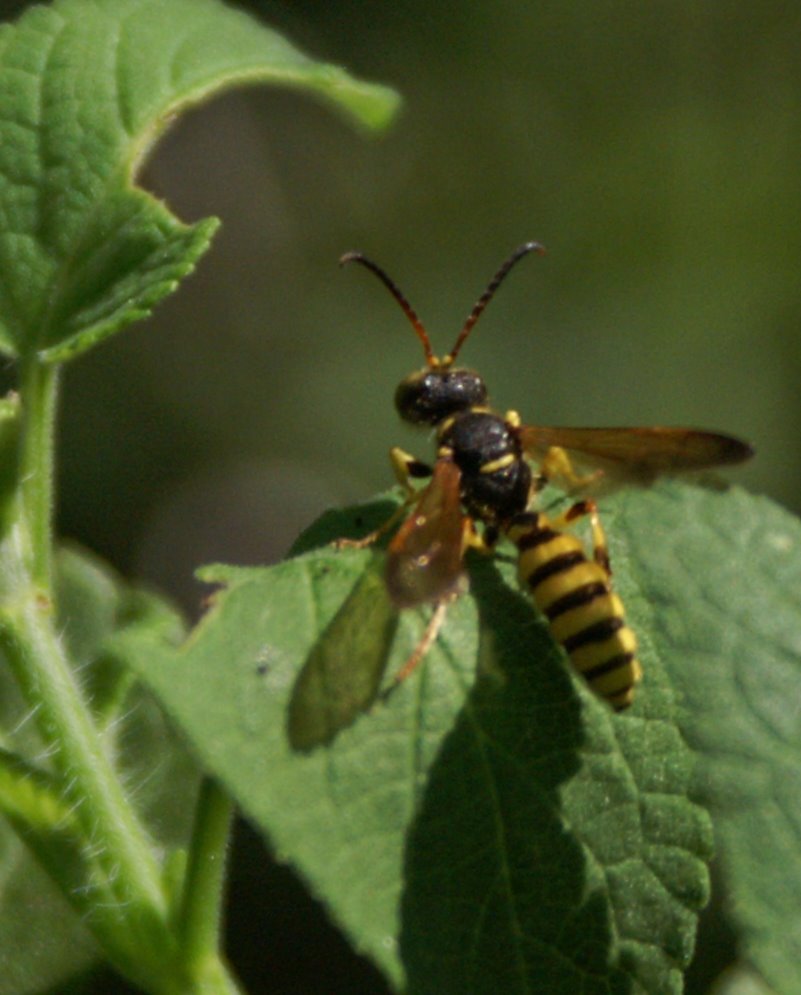
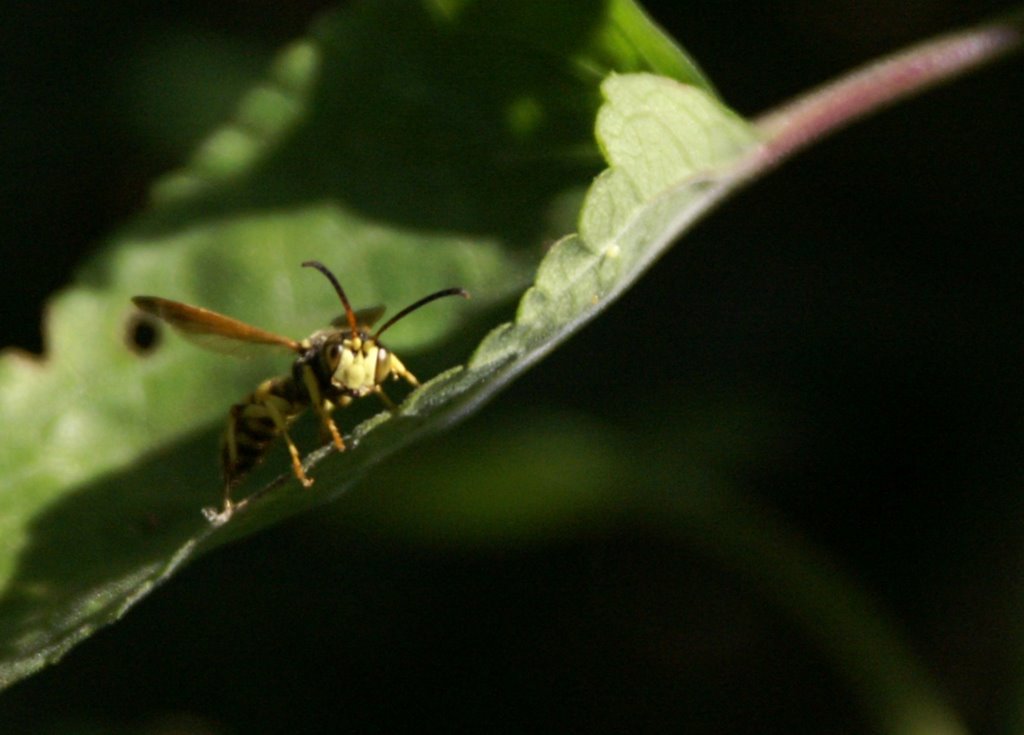
The advertisement by wasps that they are indeed wasps is known as aposematic coloring. Although unsure of which species of wasp this is, I know enough, having been taught by previous wasps (and bees!), to use caution while approaching. Those other wasps were yellow and black and a few of them stung me. The contrasting colors advertise danger to would be predators or photographers. Clever how insects came up with the same color scheme as those piso mojado signs in Del Taco that warn us of squished salsa packs on the floor. The yellow and black stripes on a wasp (or a bee) warn birds not to eat. The main beneficiary of course is the wasp who does not die. But the bird also benefits by not getting stung. The general yellow/black theme among stinging hymenopterans is further defined as Muellerian mimicry, in which various species display the same aposematic warnings, thereby reinforcing the effectiveness of each other's protective strategy vis a vis common predators.

There are examples of human use of aposematic warnings but they are intraspecific. Who is the beneficiary of such a warning? If I see a car with a W04 sticker, I have been warned that any attempt at communication with the driver or occupants will be futile, and steer clear as it were. But they too have successfully avoided
contact with me as a result of their warning, and have been saved the nuisance of being annoyed by whatever message is emblazoned on my t-shirt that particular day. In the bigger picture of human survival, though, is this result a win-win, or a lose-lose?

Monday, May 01, 2006

May Day May Day

For lack of anything better to do today, I took a survey of bugs parading around my yard in the afternoon sun. Most of them seemed nice enough, and a few carried tiny little signs saying things like, "I pollinate your flowers, parasitize your pests, decompose your spent blossoms, and now you want me to clear out of your garden just as the weather is starting to get nice?" Well, some of these aren't actually so helpful around the garden, but each of them has a job in the big ecological scheme of things so I'll let them stick around. Darned magnanamous of me I'd say.

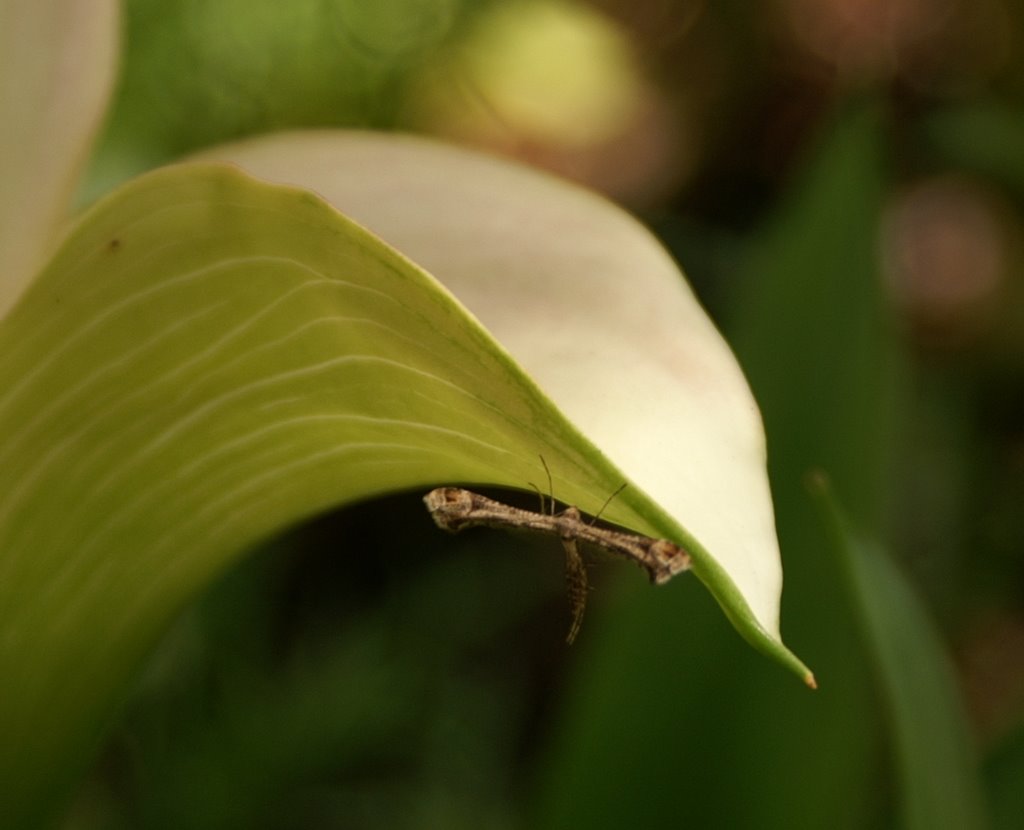
This first one is a plume moth, family Pterophoridae. There are 150 some odd described species of this family in north america, so it would be feeble for me to say I know the species. Could very well be Amblyptilia pica, geranium plume moth, or closely related to that. The larvae cause the tunneling you see in geranium leaves; and also feed on other plants like snapdragons and of all things, Indian paintbrush.

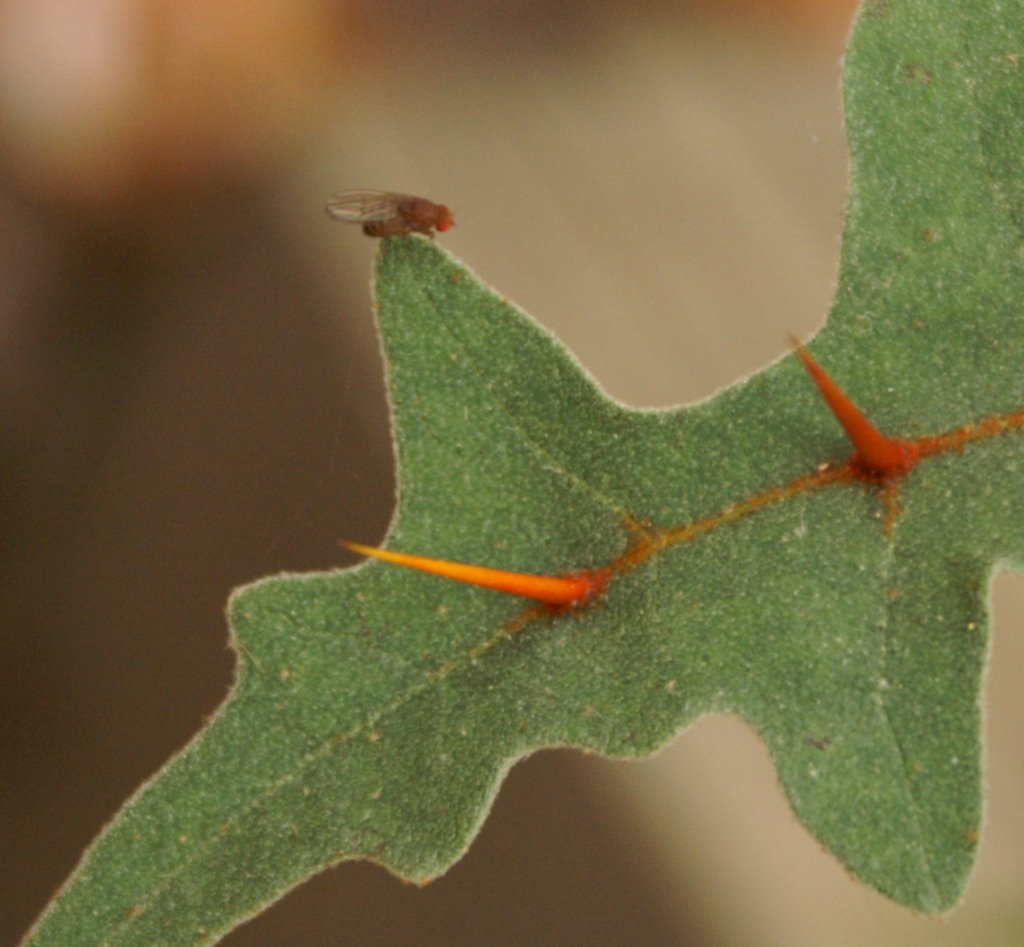
Here's a vinegar fly, Drosophila me
lanogaster. This is the so-called fruit fly of laboratory experiments involving genetics. These flies have an uncanny nose for rotting fruit and seem to appear from nowhere the minute your peach begins to turn. This one, I dunno, maybe has an eye on a squishy solanum fruit left over from last summer.


This is a nicely marked corner spider,
Hololena curta. I love it when a descriptive phrase in a guide book (Hogue)--"each web is equipped with a funnel-
like retreat running into a nearby crevice"--fits reality so neatly.


Tuesday, February 28, 2006

RVers Flunk Taxonomy Practical

The curious slogan "You know you've hit gold when the POLLYWOGS mingle with the ROLY-POLIES" wafts above Fabre-esque drawings of various creatures dutifully labeled as if in a naturalist's notebook. Except OOPS, some of them are mislabeled in this annoying advertisement found in the current National Geographic by the sharp-eyed Cindy, fellow OC bug-watcher. Far from being a smarty-pants, Cindy poses the question: Do they (the advertising hacks responsible for this mess) think nobody notices or cares about their misidentification of species in their ad?

I'll bet the answer to that question is a resounding, "Huh? What do you mean, species?" The pretty little drawings of living things are included in this layout to impart a touch of nostalgia, a dash of nature, a bit of child-like curiousity to the idea of RVing. Aside from whatever bad camping experiences you've had listening to their gennies running all night long, this ad would like you to believe RVers are really into nature and stuff. Although nowhere on their website is "gaining a broader understanding of natural history" listed as a reason to Go RVing, I suppose it was hard for these advertisers to resist using a cute little "ladybug" or whatever to promote "going just about anywhere with an RV" (! ! !) Any significance of the organism's life history, let alone its specific name, pales next to its importance in furthering the image of RVing as a warm, yummy, touchy-feelie thing to do and buy. Gee I hope too many critters weren't squished as the RVs were hauled in for photos in those pristine settings.

As for that slogan, it made me wonder whether pollywogs (which live in water except for a period when they are becoming frogs or maybe already are frogs and are trying out dry land) and roly-polies (terrestrial crustaceans aka pill bugs or sowbugs that like moist but not wet environments) ever can mingle without one of them being dead or dying from lack of oxygen. When exactly does a pollywog become a frog? Is it actually the frogs and the roly-polies that are mingling? Oh well, whatever. Pass the devilled ham sandwiches, honey. You know you've struck out when advertising hacks mess around with randon science thingies.