Search This Blog

Showing posts with label phenology. Show all posts

Monday, December 31, 2012

Year End Mantis Roundup


Lots of photos left over on the jump drive from 2012;
Stagmomantis californica edition.

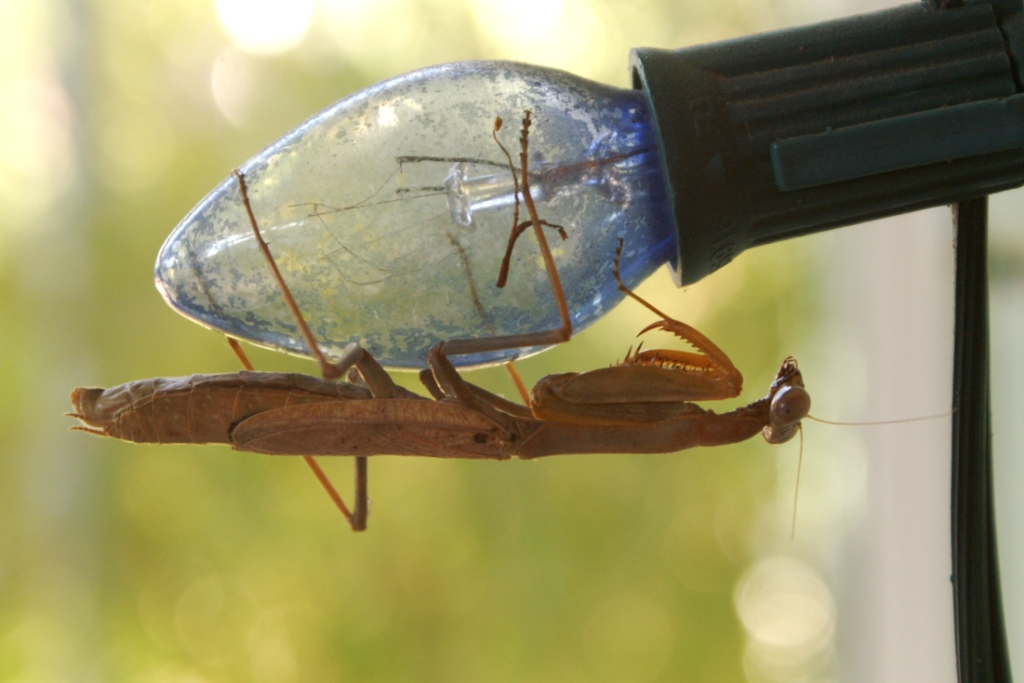
As the new year began one of the 2011 mantises was found celebrating on a C7 holiday bulb.  Cheers, and happy new year 2012.


Another adult was playing hard to get among Juan's aeonium a little bit later in January.  The days grow steadily longer but the big mantises disappear.

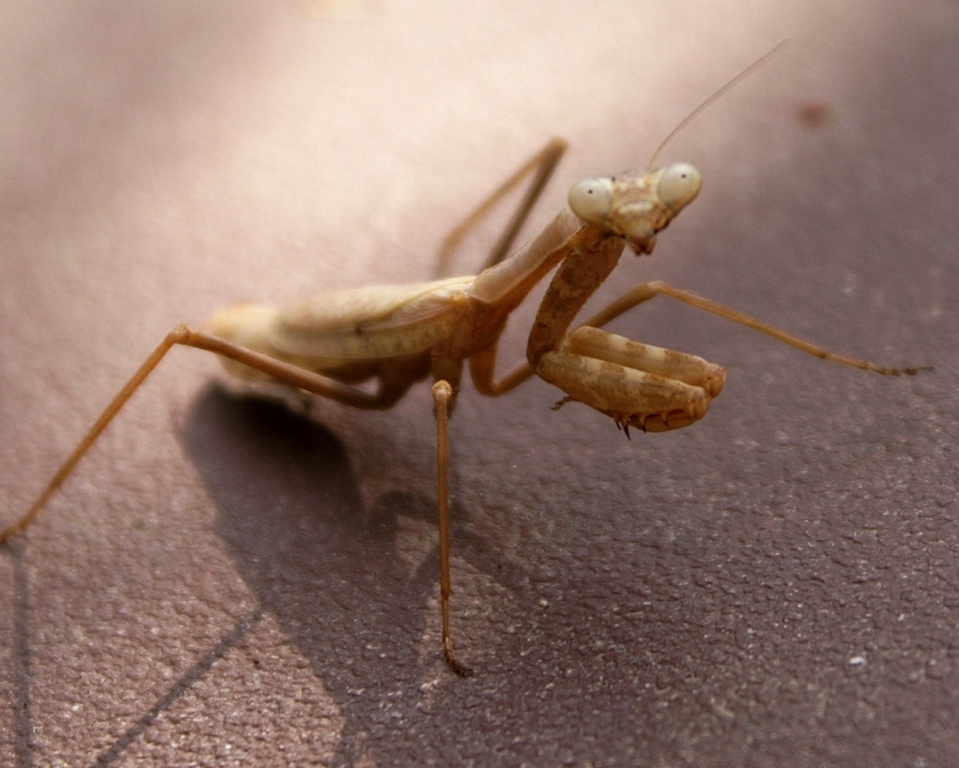
In March I started seeing tiny ones in various places.  Last photo taken in June, among the grass of June.  Then, a complete dearth of images until after Halloween.


In mid-November, as visions of upcoming Thanksgiving turkey danced in our heads, the succulent mature mantises reappeared from among the shrubberies.  This beauty showed up on a rose across the street.


A few days later this one made an appearance on top of the recycle bin.

Could this have been the same one from the rose, having hitched a ride on my shirt the other day?
A few days passed and no sign of them . . . back into the shrubberies to arise again as a January surprise in 2013?  We can only hope.

Sunday, December 16, 2012

Monarch Season


Hello there.  It's a nice chilly 57 degrees here with light rain off and on.  We've had a week or so of intermittent rain and overcast and so I'd say it's looking a lot like spring.  Yep, this time of year is when our hills green up, the mallow seeds sprout (photos later), the holiday lights go up (photos later) and of course the monarch butterflies go bonkers.

I was out back checking on things (wasting time I should be shopping?  NOT) when I couldn't help notice the milkweed dripping with fat soon-to-pupate monarch caterpillars.


There were some small half-pint caterpillars too.  On one branch the two stages met.  You can appreciate the difference a few extra weeks of eating makes in the relative sizes of the two caterpillars seen here.


The monarchs eat a lot and can completely or nearly defoliate the plant they're on.  Meanwhile the oleander aphids proliferate in huge numbers and help in the defoliation process.  Also, I suppose, the depodding.  You can see lots of alar (winged) aphids on the seed pod.


I found two small caterpillars on this nearly leafless plant; one I relocated to a more lush feeding ground.  The other one, seen here heading toward and then eating a tiny leaf bud or nub covered in aphis nerii, I left alone.  I'm sure it will be able to find enough to eat, even if it has to climb down to the ground and up another plant.


I also found a monarch chrysalis that has turned transparent so the orange of wings can be seen inside.  Soon to eclose for sure.  It's hanging in the bronze fennel, former home of the anise swallowtails.  Monarch (and other) caterpillars do often go travelling when it's time to molt and pupate, and I more often find pupae in plants other than milkweed.  That's a drop of water there among the gold spots, by the way.

I went back for another look this morning--still pupating--but found a different floppy-winged, recently-eclosed butterfly clinging to some grass along the path.  It looked weak.  Cold and drizzle seem like an unlikely recipe for butterfly success.

Heading back to the house I saw this caterpillar gone wandering among the agapanthas.  It is surely searching for a pupation spot, likely to be up on a woody stem of the phlomis, same plant where other monarchs have pupated in seasons past.
You can see its searching behavior in this photo, where the caterpillar clings with its prolegs and stretches and waves its body back and forth in an effort to make contact with suitable substrate (based on texture? firmness? orientation to the horizontal? what?) to pupate upon.


Near sunset I went out to check on the butterfly's progress.  It was lying in the path motionless.  I picked it up and in a few moments it started to move.  So I took it inside where Mr. Cardui was building a fire in the woodstove.  The butterfly was soon able to climb to the top of a twig I placed inside a wine box and seems to be resting, nestled in an upper corner, for the night.  We'll see if tomorrow brings sun and butterfly first flight.

Crazy monarch behavior: preferable to frenetic human holiday behavior?


Thursday, July 12, 2012

Anise Swallowtail #2


So a few days later on July 10 the second Papilio zelicaon butterfly emerged from its chrysalis high up in the fennel.


It's weird . . . last year there were two anise swallowtail caterpillars that survived to pupa-hood, and one of them pupated in the fennel where they all grew up and the other one climbed down out of the fennel and back up the same nearby Eriogonum giganteum as this one before strapping itself to a V shaped branch joint and making that final molt.  Are behaviors genetically programmed; and if environment plays a larger part in pupation-site selection what condition, just a few days apart in mid-summer in sunny southern California would have stimulated one cat to wander while the other one stayed put . . . or vice-versa.

Anyway, three days before this emergence I saw an assassin bug (Zelus renardii) that appeared to be attempting to predate the chrysalis.  Suddenly the pupa twitched violently and the assassin bug gave up and flew off.


The chrysalis was safe to continue ripening to a butterfly.

Luckily I was out and about fairly early when this one eclosed . . . at just past seven a.m. I found it with wobbly wings still close by its empty chrysalis.

In just a few minutes it had climbed several stem joints up the fennel toward the sun.


Leaving its empty shell behind to dry and crack.

Tuesday, July 10, 2012

Anise Swallowtail


Way back at the end of May I noticed anise swallowtail eggs on the fennel.  Yay.  There was hope this year some of the caterpillars would survive to adulthood and lead to an eventual breeding population of Papilio zelicaon on the estate.


Since then the caterpillars hatched (about June 7) and proceeded to grow from tiny bird-poop like blobs to the magnificent fully grown fatty seen here.  

A caterpillar went missing until I found it preparing to pupate on the nearby St. Catherine's lace (Eriogonum giganteum) on June 25.  It was fairly well camouflaged by the patterns of the felty leaves.


You can see the silk support girdle wrapped around the fat middle and attached to the buckwheat leaf.


And yesterday the adult butterfly emerged from its chrysalis, at first moist and crumpled looking but quickly expanding wings and climbing up the branch until it finally,


while I was not looking, flew off leaving behind its former shell glowing in the buckwheat.


Compare this year's anise swallowtail timing with 2011:

6/19/11             2nd instar caterpillar observed
711/11              Eclosure

Wednesday, May 30, 2012

Eggses


I noticed many eggs of the round, leptidopteran persuasion in the fennel today.  Little doubt that these are Anise Swallowtail, Papilio zelicaon.


I know at least one of the caterpillars from last year survived to adulthood and it's encouraging they are back laying eggs this year.  Last year's 2nd instar caterpillars were seen on June 19, so the timing this year is similar.

Maybe if this year's clutch is successful Anise swallowtails will be a more frequent sight around the place in the future.

Friday, December 02, 2011

Welcome Monarchs


Until yesterday, and since March, I've seen zero monarch (Danaus plexippus) caterpillars in the garden.
It's cold enough to wear a wooly beany during the day; chilly enough to make me to remember the long hot days of summer fondly; and wonder why there were no caterpillars during summer's bounty of succulent leaves and flowers.


But now that the milkweed is cold-purpled and thin, I find these two little guys munching away.

This one is sandwiched between two leaves . . . cozy?

Sunday, April 24, 2011

Not So Forgotten Pollinator


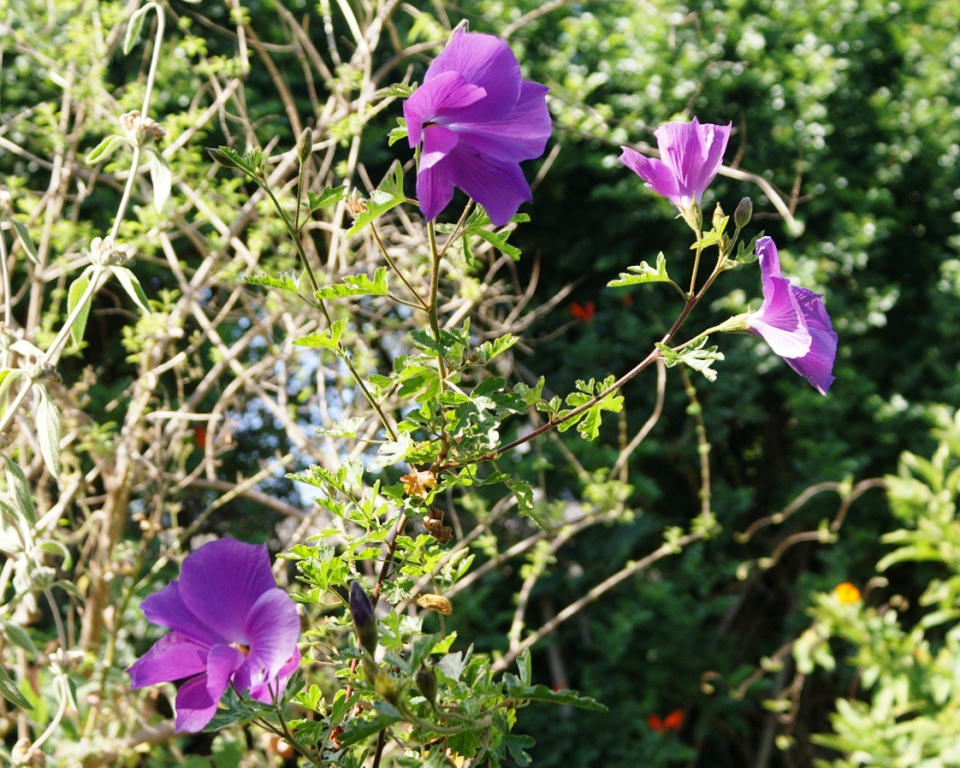
I was sitting out in the garden this afternoon reading The Forgotten Pollinators, a book about the status of pollinator/plant relationships in various environments around the world.  My reading was interrupted by loud buzzing; I looked up to see the expected male valley carpenter bee (Xylocopa varipuncta) patrolling the crown of the tallest phlomis.  The males do this in the late afternoon, hoping to attract a female with which to mate.  This particular male continued to cruise in and out of the phlomis, with occasional forays into the nearby alyogyne, for a long time.  I got chilled in the late afternoon shade and went in before the bee gave up his vigil.  You rarely see the male bees enter a flower to feed, or even pause for a moment on a twig.  Here is the male's territory; you can barely see him in the lower center portion, restlessly buzzing around.


The females, meanwhile, are most commonly found in the morning buzzing loudly inside of flowers, often mallow family flowers such as abutilon, alyogyne, lavatera, hollyhock etc.  They seem to like those wide open cup-shaped blooms.  These bees are supposedly good for pollinating tomatoes; the buzzing vibration triggers flowers to release the pollen for the bee to gather to provision her nest and meanwhile pollinates the flower's ovules.  I am hoping for a good tomato crop this year so I'm glad to see the bees around.  Anyway, I have yet to see both sexes in flight at the same time, but that doesn't mean I'll stop looking; maybe I'll hit the jackpot and see them mating some late afternoon.

So it's hard to read in my garden with so many potential distractions, but I did learn that bumblebees are the premier tomato pollinators, and are being bred expressly for hothouse tomato culture.  Since tomatoes don't produce nectar these captive bumblebees are fed artificial nectar.  I rarely see bumblebees around; I'll have to rely on the carpenter bees to get the job done.
  

I was inspired to rescue a likely stump out of the soon-to-be-split wood pile and plan to set it out in the garden as a hopeful nesting spot for bees.  The stump is pine, one of the wood species said to be preferred by Xylocopa females to drill their nesting tunnels in.

So, first sighting of male Xylocopa varipuncta this year was a few days ago.  The females were in flight at least a month earlier when the wisteria was in bloom but actually haven't been in evidence lately.