Search This Blog

Showing posts with label lacewings. Show all posts

Sunday, December 29, 2013

2013 Winter Solstice Bug Hunt and Count


Whew!  It's a lot of working trying to find buggies in the scorching winter weather we're having here in SoCal.  Didn't quite get to the count on the 21st . . . sorry traditionalists (which btw includes myself)!  Yesterday and today have been in the 80s with a dry Santa Ana wind blowing.  Typically I get some out of the ordinary bug sightings in any season with a strong wind.  I guess when you weigh that little you get blown around a bit. Not this time, really, as the count is full of the usual suspects:

SPIDERS:
Lots of funnel web spider webs in evidence, and I saw three of the spiders, Hololena curta, outside their funnels.


Found 2 very small orb weaver spiders.
Possibly metepeira.
Under some bark chunks were 2 Under Log Spiders, appeared to be male and female just hanging out;
and a very tiny tan spider attacking a smallish beetle larva.  The tiny spider ran around the larva, then jumped on it apparently biting judging from the reaction of the larva.
Near some small decorative desiccated mushrooms:  1 very tiny jumping spider not seen in this lovely mushroom photo.

1 whirligig mite, Anystis baccarum, found running around in circles.  Have you seen how fast they are?
So a lot of arachnids without much identification.

ORTHOPTERA:
1 greybird grasshopper, Schistocerca nitens, adult male.

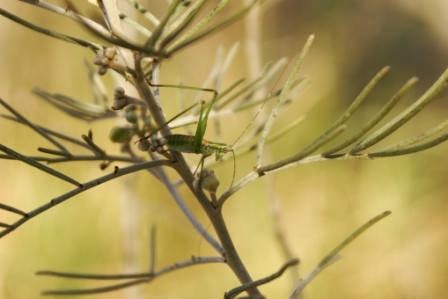
2 bush katydids, Scudderia furcata, 3rd instar nymphs, this one hanging out on the senna artemisioides which is just coming into bloom.  Flowers of all types are these guys' favorite foods.


TERMITES:


Or at least evidence of them in the woodpile.  Yikes.

BUGGIES:


1 black scale insect on a thick fennel stalk.  See the semi-circular marks on the stem near the insect?
Looks like the movement of the insect made these marks in Slo mo.
Aphis nerii, oleander aphids, by the 100s on two colonized plants.

1 Green leafhopper.
1 myrid plant bug of the all-black persuasion.

NEUROPTERA:
2 Green lacewings, Chrysopa sp.

HYMENOPTERA:
Grrrr.  There are still 100s of the neighbor's ants, possibly one of the so-called field ants.  I'll call them Formica parkwayii var: Cameronsantos for now.  Despite our efforts to poison and dissuade their colony, they continue to pour out from under our neighbor's house, march down our driveway an on into the parkway jungle where they travel several houses down and climb trees in search of honeydew and sap.  It wouldn't annoy except they climb onto me when I step out of the car at night, then wait until I'm comfy to bite me.  And they stink mightily of ant.
Only 4 honeybees, Apis mellifera, were out perusing the rosemary, acacia and lavatera flowers when I was looking.

LEPIDOPTERA:

Ding ding ding!  The adult butterflies were the stars of the count this year.
At least 3 separate cloudless sulfur, Phoebis sennae floated past my line of vision.
2 cabbage whites, Pieris rapae.
1 mourning cloak, Nymphalis antiopa, flew by in the top of the elm tree . . . hopefully laying eggs.
1 monarch, Danaus plexippus, seen flying and 1 that had recently eclosed under the cold-stressed leaf of the night blooming cereus.


FLIES:
Last but never least.


1 syrphid fly, Eupeodes sp. attracted to a basket
1 green bottle fly, Lucilia sericata resting on a leaf.
2 muscid flies of undisclosed persuasion doing what muscid flies do.
.

Slim pickings, like last year.  It's ending up to be our driest year on record here, with no predictable rain in sight.  Oh wait.  The Old Farmers' Almanac sez:

 DECEMBER 2013: temperature 54° (avg.); precipitation 2" (1" above avg. north, 0.5" below south); Dec 1-5: Rain, then sunny, cool; Dec 6-10: Heavy rain north, showers south; cool; Dec 11-15: Rainy periods, cold; Dec 16-21: Rainy periods, some heavy; cool; Dec 22-31: Clouds and drizzle, cool north; sunny, turning warm south.
JANUARY 2014: temperature 53° (1° below avg.); precipitation 8" (5" above avg.); Jan 1-3: Clouds and occasional drizzle, cool; Jan 4-10: Heavy rain, then sunny, chilly; Jan 11-14: Heavy rain, mild; Jan 15-16: Showers; Jan 17-19: Heavy rain, mild; Jan 20-24: Rainy periods, cold;Jan 25-27: Sunny, cool; Jan 28-31: Rainy, cool.
We, the plants, the birds and the buggies and the publishers of the Old Farmers Almanac can only hope.


Friday, December 21, 2012

8th Annual Winter Solstice Bug Count


Ye doggies, I've been doing this for 8 years now?  Time flies when you're geeking out over bugs.
Anyway, it was a clear and cold middle of the day on the solstice and these were my finds:

ARACHNIDS--8 Legs!
1 labyrinth orb weaver, Metepeira [labyrinthea?]


These gals are so cute with their huts made of local-sourced building materials!


1 very small, shiny brown jumping spider.
6 Funnel web spiders mostly hiding in their lairs in the cracks on my porch ceiling, Hololena curta.

1 Anystis baccarum, predatory mite aka whirligig mite.  I interrupt this recitation to clarify that this count does not by any means purport to be an exhaustive nor complete inventory of the buggies on my estate.  Seeing and recording just the one mite running crazily over and under the concrete birdbath in the front garden merely indicates that the species Anystis baccarum is represented, albeit thinly, in the fauna on this particular day.  Probably there are many more of them . . . somewhere.  Or, their eggs.  And that goes for all species listed here . . .
Lots of Aceria granati, pomegranate leaf curl mites.  I haven't yet solved this pest problem on my poor poor pomegranate tree.

HEMIPTERA--Suckers, hoppers and true bugs!


100s mealybugs adult and nymphs on the pittosporum and Juan's aeonium.
Lots of pittosporum psyllids on, what else?, pittosporum.
1000s Aphis nerii, oleander aphid, covering the nearly bare stems of the milkweed plants.  Winged and wingless forms were both plentiful.

10 or so scale insects on the fennel.  Often the ant colony that lives under my neighbor's parkway strip sends troops north along the gutter to this fennel plant to harvest honeydew from the scale ranch they operate here.  This day no ants were at work in the fennel, however.
3 small black-ish leaf hoppers, maybe Scaphytopius sp.


Just One of each of the following true bugs:
small milkweed bug, Lygaeus kalmii; 


LARGE milkweed bug, Oncopeltus fasciatus;
and pirate bug,Orius tristicolor.

NEUROPTERA--Lacewings!


1 Lacewing egg and 1 adult green lacewing, Chrysopa sp

ORTHOPTERA--Jumpers!


1 bush katydid nymph, Scudderia furcata

LEPIDOPTERA--Flutterbys!


1 monarch adult, and 15 larvae, Danaus plexippus.


Some of the caterpillars are dark-looking.  Are they infected with OE parasites?  This website describes some findings that suggest caterpillars that are dirty-looking, have indistinct stripes or malformed "antennae" could be signs of infection.  Other sources agree that monarch caterpillars are normally often darker colored in winter so they absorb more heat from the sun.  It would be nice to know.
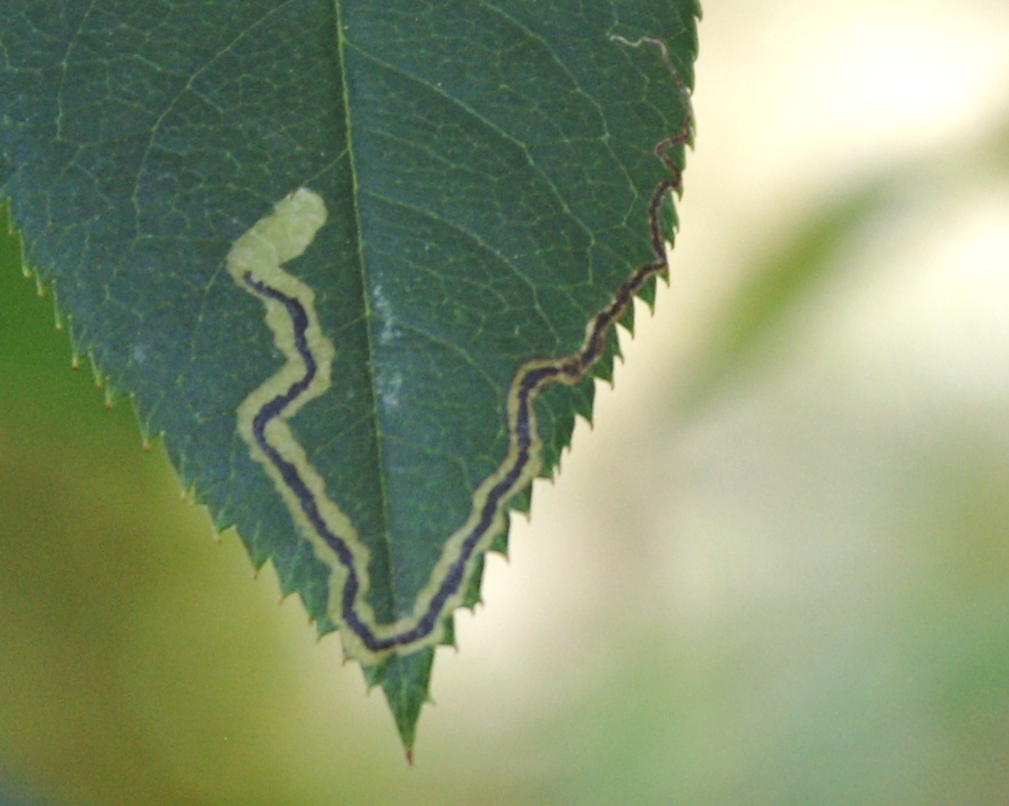
7 Stigmella rosaefoliella mines on rose leaves . . . Rose leaf miner.  This is a first observation of this in my garden.  The mines, which are remarkably similar in shape to each other, are the result of the feeding of moth larvae.  Here is an image of the moth.


DIPTERA--Flies!
1 Green bottle fly, Lucilia sericata.
3 Flesh flies of some sort, Sarcophaga sp.
10 Syrphid flies, Allograta obliqua.  These guys are so attractive, and it's nice to see them on the job parasitizing aphids.


And, several to many different types of unidentified flies.  One of these looked lot like boatman fly, but wasn't.

HYMENOPTERA--Stingers!


100s of ants.  Still don't know what species these are.  The typical worker is larger than an Argentinian; has reddish thorax and darker head and abdomen.  They stream from and back to the colony entrance under my neighbor's parkway into our yards and trees.  Often they climb onto my foot, and end up biting me.  They smell strongly (to me) of ANT.
3 Apis mellifera, honey bees.  This one is nectaring at the one red buckwheat (eriogonum grande rubescens) flower unseasonably available . . . Why?

Where did all of them go that were swarming the willow wattle just a few days ago?
1 Paper wasp, polistes exclamans.

Quite a few empty nests of same or similar.


BEETLES!
Ladybirds that is.
1 spotless ladybird, Cycloneda sanguinea.

1 Asian ladybird, Harmonia axyridis.


8 undifferentiated ladybird pupae


and one ladybird larva that appeared to be consuming another.

Maybe I'm jaded, but this count seems like slim pickings compared to years past (well, the cannibal ladybirds and rose leaf miners were exciting . . . ).  Did the weather have anything to do with that?
The average high and low temperatures for Dec the past 4 years recorded at our nearest CIMIS station (75--Irvine):
2012 high 62.8  low 44.7
2011 high 65.5  low 40.8
2010 high 64.6  low 44.7
2009 high 67.1  low 45.9
would seem to indicate this solstice about average.


But closer examination of the daily data reveals we had a freeze or near-freeze the two nights preceding my bug count.  We know that freezing temperatures (or in our case, the lack of them) effects pest insect population spread.  Could two nights of just barely frost have a noticeable effect on insect activity in my garden?


Saturday, July 21, 2012

Some Smallish Random Things


Crossed wings near the /presumed/ spot where a green lacewing died on a salvia stem.

A small /dead/ bee suspended in spider silk beneath a web full of fennel flower fluff.


The opening of an Indian mallow flower attracts the /tiny/ attention of a tiny looper caterpillar.


A small fly /seems to be/ impaled on the spine of a euphorbia.
How?

Sunday, June 19, 2011

Things in the Fennel


It was one of the final days of the legendary April-May-June gloom of 2011 and I was strolling past a fennel plant (Foeniculum vulgare) that overreaches the pathway with its vulgarity, when a white/orange/black thing of an unusual shape and size caught my eye.  Looking closer I saw it was a bit of the trailing edge of a monarch butterfly wing.  Yay, great find! I thought as my normally down-glancing eyes luckily decided to move up the fennel plant and so happened to notice another white/orange/black thing that was more interesting:

Oh My Gorsch . . . it was a small caterpillar of the swallowtail persuasion.  I thought this because the overall, out of the corner of the eye first impression was strongly bird-dropping-esque bringing to mind the caterpillar of the Giant Swallowtail.  Checking my resources later confirms this to be a second instar Anise Swallowtail larva, Papilio zelicaon.  The fact it was feeding on fennel, possibly the most utilized larval food plant for this species in this area, of course supports the identification.  Very exciting to find this new species breeding in the yard; turns out there were four little ones working on the annihilation of the upper portion of this fennel plant on this particular day.


Also found among the feathery reaches of the fennel were a tiny down feather in a similar color scheme as the wing bit and the caterpillars . . . maybe a towhee feather or maybe that of a house finch.  I recently followed a towhee (Pipilo crissalis) as it walked down the sidewalk in front of my house.  It was a very odd feeling.

Then there was one green lacewing egg.  This one is a bellwether of the coming tide of lacewing eggs that will proliferate on the tips of vegetation as soon as the weather warms up and the prey populations explode.

And there was also a fennel inflorescence just opening up.  These graceful flowers open slowly and dramatically in the languid cool sun of summer 2011.

Tuesday, January 25, 2011

one egg on a fuzzy schizocarp


I've gone poetic in the past about lacewing eggs.  They appear delicate, tenuous, ethereal.  But in reality the stalk they rest upon is exceptionally resilient and while this egg itself may fall prey to various fates, eggs, and more importantly their contents, continue to prevail in sufficient quantities to prolong the existence of lacewings.  An individual egg as seen here stands alone like a punctuation mark, an embellishment on the mother lacewing's statement about life.

This egg is attached to the dried schizocarp of Pavonia praemorsa, full of seeds that may or may not ever sprout.

Tuesday, January 11, 2011

A Quarter Hour in the Grass


There is a clump of pennisetum growing in the parkway, planted a year or so ago I think and I've misplaced its proper name.  Maybe it's p. a. hameln.  By rights it should be cut back soon but meanwhile and as long as I'm procrastinating garden chores it is a wild place of tangled leaves, scraggly blossoms and home to many things. 

Just a quarter hour's observation revealed katydid eggs glued in overlapping rows on a stem; a weird colored bagrada hilaris nymph clinging to an inflorescence;


 a glowing elm leaf; a schistocerca nitens grasshopper nymph casting an annoyed look at me as I parted the foliage; a green lacewing perched gracefully on a twisting leaf; a geometrid caterpillar of uncertain coinage; and the simple but irresistible combination of milkweed seed meeting grass seed.


Take time to observe, always time to trim later.