Search This Blog

Showing posts with label mysteries. Show all posts

Thursday, April 23, 2015

Athanasia acerosa and friends


So my mystery plant is no longer a mystery.
Years ago I found a scraggly one gallon shrub with interesting leaves etc at Daylily Hill Nursery in Escondido (hidden . . . get it?).   The nursery worker really did not know what it was, nor did I, nor could I find anything like it on the internet and even my plant geek nephew couldn't place it.  But I planted it anyway, and imagined it to be akin to the beautiful and bountiful rabbitbrush seen in New Mexico on a summer trip.

The thing has grown well in my parkway, land of little irrigation and not too much rain these past few years.  It's now about 4 feet all around and covered in yellow flowers, and it even has offspring of the cloned persuasion accompanying it further on down the strip.  One time Mr. Cardui and I saw one, a big one about 8 feet tall, also covered in flowers as we drove down a nearby business district avenue.  The thing is, this is a plant that makes itself noticed while in bloom and then, after the flowers fade it goes unnoticed.

Well, I took another trip to Escondido, same nursery under a new name and what do you know?  They had a full block of the mystery plant for sale.   So say a proper hello at last to "Athanasia acerosa" also known as Coulter bush.  Hales from South Africa.  Not a lot of info about it out there, but here's what I've learned:

A bit hard to get started from cuttings, but worth a try.  Not sure what the ultimate size is.  It grows long stems from the base which flower on the ends.  I've had good luck cutting these back halfway or even all the way to the base.  Next year new stems sprout.  Young plants are really leggy, but can be cut back in the same way to get them more bushy and full.  Doesn't need much water. The flowers are sweetly fragrant and they attract a lot of small buggies.


I saw various plant bugs (seriously, miridae),

spittle bugs (Clastoptera lineatocollis), aphids (unidentified very small black ones) and evidence of their wasp parasites (over half were mummified), a ladybird beetle (Asian),


a molting sharpshooter-style leafhopper (likely Homolodisca vitripennis) and where there's prey there's the apex predator of its little golden flowery world:  a mantis nymph (Stagmomantis).


So, one tiny null zone of information has been filled in, a whole tiny world of unanswered or even yet to be imagined questions.


Saturday, May 04, 2013

Swarm


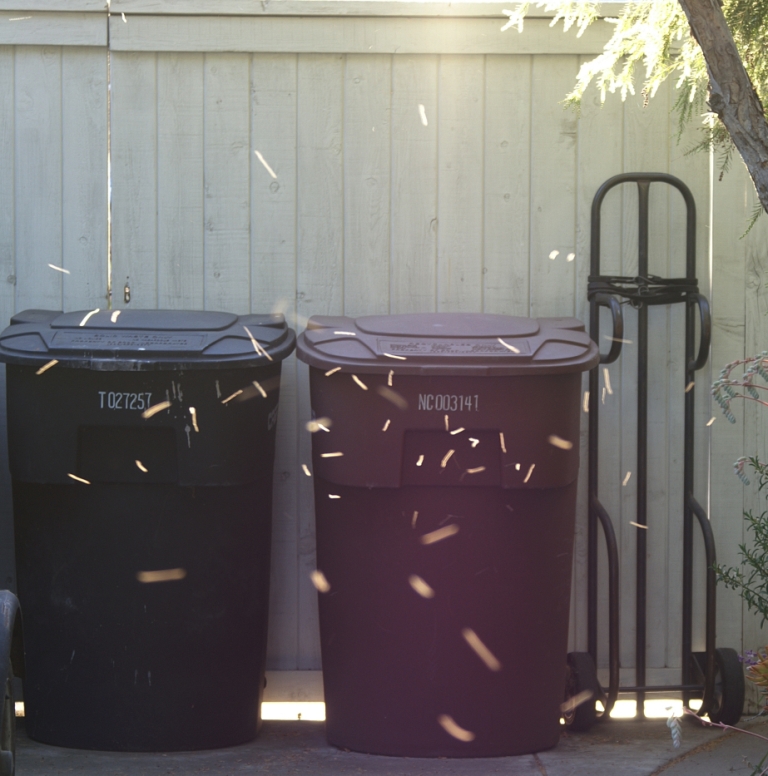
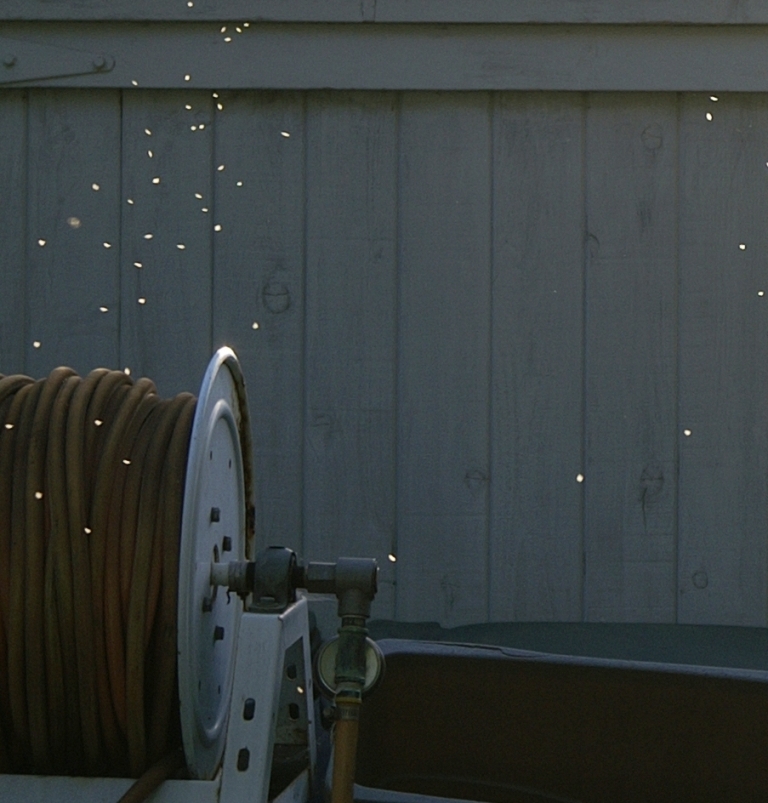
There's a spot in our driveway-- just east of the fence, under the overhanging melaleuca branches, north of the neighbor's camellia trees and above the disused spray rig, trashcans and miscellaneous detritus --where small flies gather at sunset and swarm.


I think they look really cool glowing in the angled sunlight.  Is it the sunlight bouncing off the tree branches or the fence top that is their swarm marker?


Their behavior resembles the description on of Dance Flies on bugguide see excerpt below.  Yeah, I should net one or two of them and attempt to identify.


Remarks

In mating swarms, males fly up and down in a sort of dance. They have captured an insect, wrapped it in silk, and hold as an offering for females. Females seem to choose the male with the most enticing offering. Sometimes a male may offer just an empty ball of silk.
 Males with "nuptial balloons"
Paul Beuk on swarming:
You may have male swarms, female swarms and mixed swarms. In the case of the first two it may be that the other sex does not form swarms but joins the existing swarm for mate selection, or there are nearby separate swarms and specimens from one of those leave for the other to select a mate.
Different species swarm at different times of day. Some may swarm during the whole day, others maybe only for an hour at dusk, etc.
The location of the swarm is determined by markers. These may be very specific (under an overhanging branch in the sun, so the swarms may move with the sun) or rather 'generally defined' (along a slope, creating a very 'long' swarm, or over the water surface in a brook).
Nuptial gifts are not known for all mating dance flies. They are mostly found in the Empididae Empidinae (in genera like Empis, Rhamphomyia, Hilara) (the latter including the balloon flies).

Tuesday, April 02, 2013

Chair-lotte's Web?


I found an unusual web on the back of a patio chair the other day.
Some Chair!

The chair, which I am planning to restrap, was stored in a back room indoors.  When we brought it out into the light, the web was revealed.  I couldn't find a spider in residence, though there were a few small (+/- .25") shed spider skins and some dessicated prey.

I also haven't been able to find any image of a web that resembles this, especially the double-strand zigzag motif.  Aside from the fictional weavings of Charlotte, the closest thing is images of the webs of drugged spiders, part of a couple of experiments on the effects of various drugs on spiders.  The caffeine- and chloral hydrate-induced webs bear a glancing similarity.  Where would the spider lurking in a dusty back room get caffeine or a Mickey Finn?

I'm going to have another look for the spider; meanwhile . . . Anyone ever seen a web like this?

Saturday, July 21, 2012

Some Smallish Random Things


Crossed wings near the /presumed/ spot where a green lacewing died on a salvia stem.

A small /dead/ bee suspended in spider silk beneath a web full of fennel flower fluff.


The opening of an Indian mallow flower attracts the /tiny/ attention of a tiny looper caterpillar.


A small fly /seems to be/ impaled on the spine of a euphorbia.
How?

Thursday, July 12, 2012

Anise Swallowtail #2


So a few days later on July 10 the second Papilio zelicaon butterfly emerged from its chrysalis high up in the fennel.


It's weird . . . last year there were two anise swallowtail caterpillars that survived to pupa-hood, and one of them pupated in the fennel where they all grew up and the other one climbed down out of the fennel and back up the same nearby Eriogonum giganteum as this one before strapping itself to a V shaped branch joint and making that final molt.  Are behaviors genetically programmed; and if environment plays a larger part in pupation-site selection what condition, just a few days apart in mid-summer in sunny southern California would have stimulated one cat to wander while the other one stayed put . . . or vice-versa.

Anyway, three days before this emergence I saw an assassin bug (Zelus renardii) that appeared to be attempting to predate the chrysalis.  Suddenly the pupa twitched violently and the assassin bug gave up and flew off.


The chrysalis was safe to continue ripening to a butterfly.

Luckily I was out and about fairly early when this one eclosed . . . at just past seven a.m. I found it with wobbly wings still close by its empty chrysalis.

In just a few minutes it had climbed several stem joints up the fennel toward the sun.


Leaving its empty shell behind to dry and crack.

Wednesday, July 11, 2012

Milkweed bug sociology


The large milkweed bugs are in full flame in the garden, congregating mostly on the milkweed of course.  The top picture is a dense aggregation of nymphs on a dried milkweed seed pod.  You can see some shed exoskeletons there near them.  These bugs commonly clump together like this, often in mixed age groups but sometimes more like-aged as these are.  The eggs are laid on or in the green milkweed pods; since a female may lay 1000s of eggs it really is no surprise to find huge bunches of these bugs during their seasons.


Here you can see the milkweed seeds among the bugs.

Sometimes the milkweed bugs spread out and explore other plants.  The nymphs supposedly feed only on milkweed seeds; their motivation to wander is therefore unexplained to me so far.  Adults may feed on nectar or plant juices and of course wandering might be related to mating activity.  Here is a nicely posed small group with an adult,  a freshly molted adult and a couple of sub-adults along with a shed exoskeleton.

And sometimes a milkweed bug just wanders off by itself.  This one was found on the buckwheat (eriogonum giganteum).

As for the species name Oncopeltus fasciatus, the Latin translates to something like "banded little shield" and should by no means be confused with neither necrotising fasciitis nor Mr. Cardui's current affliction Plantar fasciitis.  While the PF has adversely affected the Mister's sociology including his ability to wander or even hobble sometimes, he still gamely sallies forth into the weekend yard sale scene with me.  We're just a pair of large rummage bugs, perhaps.

Tuesday, May 22, 2012

Still Life with Opuntia and Dusty Miller


Scene from the early summer garden for your viewing pleasure.
And,

Guess what is this?

Sunday, April 15, 2012

Blooms Avec Bugs


A few samples from the bloom-bug continuum, April edition.


This honeybee (Apis mellifera) demonstrates technique for nectar extraction from the complicated flower of Phlomis fruticosa.  I watched honeybees working the Jerusalem sage for awhile and discovered the majority of them use this upside down position, while a few attempted to enter the nectar tube from the bottom, crawling up the lower lip of the flower.

The carpet beetle (Anthrenus verbasci) adults are out in force now, eating the disk flowers on my daisies and seeming to especially favor the tiny flowers of the not obviously daisy-like Ozothamnus, which of course are also daisies (Asteracea).  I guess the bugs' primitive daisy radar is in line with our big-brained taxonomy.


I still haven't identified this plant since our first encounter.  Let's call it rabbitbrush for now and possibly ever.  The lygus bugs that live on this plant haven't changed either, and have either arrived or arisen from their overwintering just like in springs past.  I think this one is Lygus lineolaris, but it could be another similar species.  Lygus bugs are well-known plant pests, but the rabbitbrush seems to prevail.

Tuesday, July 12, 2011

First Mantis


I noticed this mantis the other day as I was preparing to water the adenium plant it was lurking on.  At first I thought it was a molted mantis husk because it was so light in color.  I reached out to examine it and it moved on up the sparsely leafed and heavily thorned branch it was on.


Later I found the actually shed exoskeleton dangling from another branch, much less lively but similar in color to the real mantis.


This looks like Stagmomantis californica, the species of mantis that has been stalking my garden, except the coloration is much lighter and the stripes on the legs are missing.  In this previous post is a mantis of the same age showing the coloration I typically see.  I know there is color variation in California mantis, and I also wonder if they have some ability to change color to match their environment.  This light one blends in so well with the shiny grey bark of the adenium branches.

I also wonder how many insects it takes to grow a mantis.  Not only is this adenium sparse (not sure which species it is but it has much fewer and smaller leaves and flowers than the typical Desert Rose you see), but it is growing in a pot on the patio, making for what I imagine are slim pickings in the prey department.  Still, the little white mantis continues to stalk among the thorns, the first and only mantis I've seen in my garden this year.

Wednesday, June 15, 2011

Bloom Day Solanacea


We planted up some big pots with veggies in April including tomatoes and what the garden gurus identify as good companions such as onions, mint, nasturtiums, marigold and geranium as well as "other nightshades" (eg tomatoes, peppers, potato, eggplant, and well, nightshade?)  I happened to have a one gallon Solanum wallacei, Catalina nightshade, hanging around the yard looking for a home so I popped it into one of the pots.  It spills out of the pot with long stems covered in downy leaves and sprays of purple tomato flowers.

I was wondering one day as I watched flies and bees working the flowers: whether pollen transfer from the poisonous nightshade could effect the fruit quality of the tomatoes, as is the case sometimes with cross-pollinated squashes.

The tomato plants are loaded with fruit that is just turning red:  we will keep an eye out for signs of poisoning as we enjoy their juicy goodness.  Meanwhile the nightshade has set no fruit so far.