Search This Blog

Showing posts with label beetles. Show all posts

Sunday, August 23, 2015

Rank Amateur says "Nuts"


Nuts.  I failed, I am such an amateur.
Sure, I noticed this beetle suspended in its small way from a pot rim on my porch.

I came down to its level for a closer look and saw it was caught up in spider silk.
And then saw the spider.


Watched the spider approach its comparatively enormous prey from the ventral aspect and
inject venom. Probably between abdominal segments.
The beetle struggled, flexing and spinning for a few seconds then stilled.
I snapped a few photos.


But,
I neglected to count the segments on the beetle's antennae
(looks like 11 in the photos, 11 beadlike segments).
It didn't occur to me to take note of the beetle's tarsal formula:
was it 5-5-5 ( five segments on each of the tarsi fore middle and hind )
or was it 5-5-4?
Or whether there were cleaning combs on the foreleg spurs.

Darkling (tenebrionid) or ground (carabid) ?
Maybe there's some subtle difference in flavor between these two large beetle families, and
I could ask the spider to weigh in here for a positive ID.
Or next time, just be a little more systematic in my observations.


Sunday, October 05, 2014

Cotinis mutabilis


These big shiny green beetles are well known as fruit eaters.  When we had the fig tree in the nursery, they lived up to their common name 'Fig eater beetles' by attacking and eating the ripe figs enmasse.  Actually, that's one reason we got rid of that fig tree.  The other being, don't particularly like figs or stepping in the fallen ones while doing chores.

But I've also seen these beetles spending a lot of time on flowers, like this one on the bulbine frutescens.  Since Cotinis mutabilis is attracted to sweets (fruit, fruit juice) they could be eating nectar and maybe, incidentally, flower parts.  Cotinis are in the larger group of fruit and flower chafers (Cetoniinae) which includes many flower eating beetles.


It's almost the end of Green Peach beetle season and soon we will miss their big clumsy noisy flights over our heads and bumping into things.  The eggs are laid in the mulch or manure, the larvae will grow over the winter and emerge next summer.  I guess if you grow fruit you would consider these a pest, but we see them as a sign of summer and a cause for wonder:


If a creature this shiny and clumsy and loud can thrive, Earth must be a friendly place.

Ha.  Actually all they require is a likely pile of mulch or compost, and a lack of flooding rains over the winter and the next generation is almost assuredly going to emerge.  They fly far (ever been in the middle of a large parking lot and been buzzed by one?) so if you're trying to eliminate them from your fruit trees, you'll need to get your neighbors to participate in mulch removal as well.


Friday, September 13, 2013

Short Parade of Parkway Bugs


A recent survey of the parkway strip insect population amounted to a minor parade of species, heavily weighted in the Hemipteran catagory, including assassin bugs (Zelus renardii) in three stages of life.  The small nymph in the header photo enacts the stalking of prey among big scary shadows of fennel flowers.  Nearby an adult assassin displays a morsel stuck to its foreleg.


These guys use "sticky trap predation", secretion of a sticky substance on the legs which performs like the traps of insectivorous plants.


A little bit further away this cluster of assassin eggs rides a float crafted of leucadendron leaf.

The white bands on the antennae of these katydids identifies them as Scudderia furcata, strolling by along Salvia greggii foliage.


In the 3rd photo, a spittlebug hides within its spittle wad to the above right of the katydid's head.


Green stinkbugs, Nezara viridula, were in evidence represented by this 3rd instar waving from the spent flowertops of the salvia.

Two tribes of aphids represented their suborder Sternorrhyncha, arrayed in precision rows and waggling sometimes in unison sometimes out of step.  Large groups of placard-less (aka yet to be identified) aphids lined up and down the stems of cosmos.  A couple of ants patrolled the ranks of aphids.

And the ever-popular Aphis nerii glow bright yellow among the milkweed.


Ladybug eggs, similarly outfitted in gold/yellow, dream of the day they will feast on said aphids.

Thursday, April 04, 2013

Spring, with a Side Order of Juan's Aeonium


This is actually Daughter of Juan's Aeonium (Aeonium arboreum): a cutting from the original plant which flowered this spring.  The mother plant also flowered; it seems like an every other year or so event with this plant.


Anyway the honeybees are glad because they seem to love these flowers that appear to be rich in nectar.

Other buggies enjoying the aeonium are carpet beetles (Anthrenum verbasci) feeding on flower parts.  Remember, the larvae of these beetles are the potential pest since they feed on animal fibers such as wool (hence the common name) but also spider web.  But the adult beetles not so.


I also saw a lone winged aphid.  But where there's one there may soon be many.


Friday, December 21, 2012

8th Annual Winter Solstice Bug Count


Ye doggies, I've been doing this for 8 years now?  Time flies when you're geeking out over bugs.
Anyway, it was a clear and cold middle of the day on the solstice and these were my finds:

ARACHNIDS--8 Legs!
1 labyrinth orb weaver, Metepeira [labyrinthea?]


These gals are so cute with their huts made of local-sourced building materials!


1 very small, shiny brown jumping spider.
6 Funnel web spiders mostly hiding in their lairs in the cracks on my porch ceiling, Hololena curta.

1 Anystis baccarum, predatory mite aka whirligig mite.  I interrupt this recitation to clarify that this count does not by any means purport to be an exhaustive nor complete inventory of the buggies on my estate.  Seeing and recording just the one mite running crazily over and under the concrete birdbath in the front garden merely indicates that the species Anystis baccarum is represented, albeit thinly, in the fauna on this particular day.  Probably there are many more of them . . . somewhere.  Or, their eggs.  And that goes for all species listed here . . .
Lots of Aceria granati, pomegranate leaf curl mites.  I haven't yet solved this pest problem on my poor poor pomegranate tree.

HEMIPTERA--Suckers, hoppers and true bugs!


100s mealybugs adult and nymphs on the pittosporum and Juan's aeonium.
Lots of pittosporum psyllids on, what else?, pittosporum.
1000s Aphis nerii, oleander aphid, covering the nearly bare stems of the milkweed plants.  Winged and wingless forms were both plentiful.

10 or so scale insects on the fennel.  Often the ant colony that lives under my neighbor's parkway strip sends troops north along the gutter to this fennel plant to harvest honeydew from the scale ranch they operate here.  This day no ants were at work in the fennel, however.
3 small black-ish leaf hoppers, maybe Scaphytopius sp.


Just One of each of the following true bugs:
small milkweed bug, Lygaeus kalmii; 


LARGE milkweed bug, Oncopeltus fasciatus;
and pirate bug,Orius tristicolor.

NEUROPTERA--Lacewings!


1 Lacewing egg and 1 adult green lacewing, Chrysopa sp

ORTHOPTERA--Jumpers!


1 bush katydid nymph, Scudderia furcata

LEPIDOPTERA--Flutterbys!


1 monarch adult, and 15 larvae, Danaus plexippus.


Some of the caterpillars are dark-looking.  Are they infected with OE parasites?  This website describes some findings that suggest caterpillars that are dirty-looking, have indistinct stripes or malformed "antennae" could be signs of infection.  Other sources agree that monarch caterpillars are normally often darker colored in winter so they absorb more heat from the sun.  It would be nice to know.
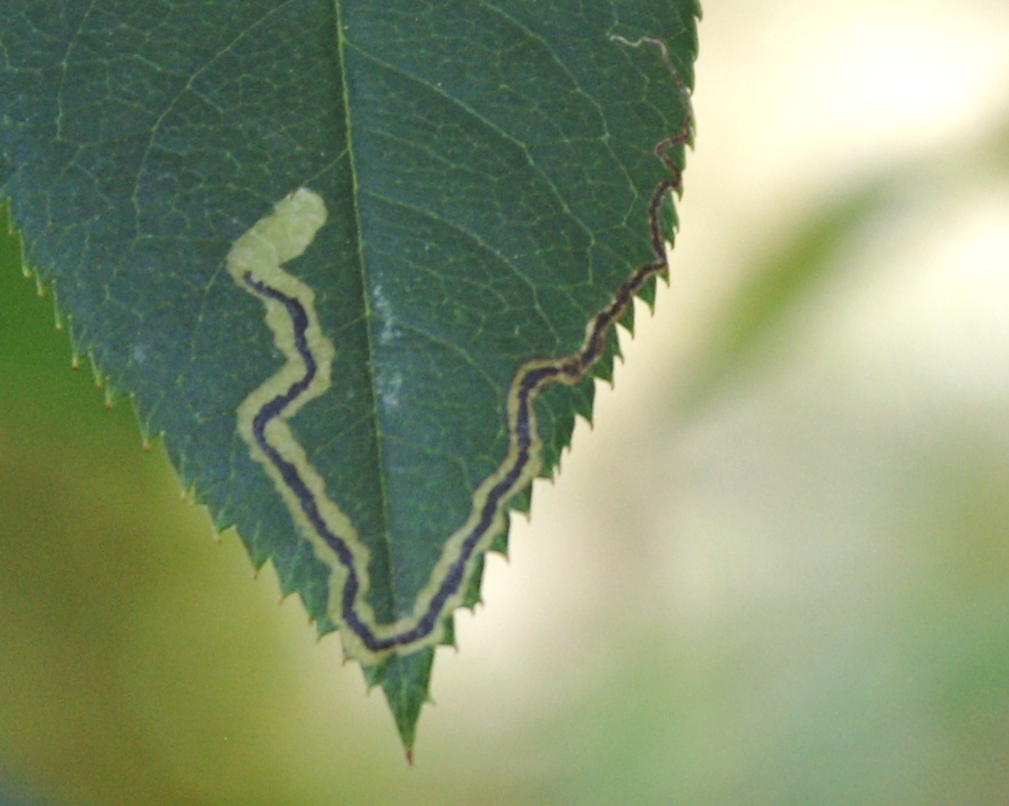
7 Stigmella rosaefoliella mines on rose leaves . . . Rose leaf miner.  This is a first observation of this in my garden.  The mines, which are remarkably similar in shape to each other, are the result of the feeding of moth larvae.  Here is an image of the moth.


DIPTERA--Flies!
1 Green bottle fly, Lucilia sericata.
3 Flesh flies of some sort, Sarcophaga sp.
10 Syrphid flies, Allograta obliqua.  These guys are so attractive, and it's nice to see them on the job parasitizing aphids.


And, several to many different types of unidentified flies.  One of these looked lot like boatman fly, but wasn't.

HYMENOPTERA--Stingers!


100s of ants.  Still don't know what species these are.  The typical worker is larger than an Argentinian; has reddish thorax and darker head and abdomen.  They stream from and back to the colony entrance under my neighbor's parkway into our yards and trees.  Often they climb onto my foot, and end up biting me.  They smell strongly (to me) of ANT.
3 Apis mellifera, honey bees.  This one is nectaring at the one red buckwheat (eriogonum grande rubescens) flower unseasonably available . . . Why?

Where did all of them go that were swarming the willow wattle just a few days ago?
1 Paper wasp, polistes exclamans.

Quite a few empty nests of same or similar.


BEETLES!
Ladybirds that is.
1 spotless ladybird, Cycloneda sanguinea.

1 Asian ladybird, Harmonia axyridis.


8 undifferentiated ladybird pupae


and one ladybird larva that appeared to be consuming another.

Maybe I'm jaded, but this count seems like slim pickings compared to years past (well, the cannibal ladybirds and rose leaf miners were exciting . . . ).  Did the weather have anything to do with that?
The average high and low temperatures for Dec the past 4 years recorded at our nearest CIMIS station (75--Irvine):
2012 high 62.8  low 44.7
2011 high 65.5  low 40.8
2010 high 64.6  low 44.7
2009 high 67.1  low 45.9
would seem to indicate this solstice about average.


But closer examination of the daily data reveals we had a freeze or near-freeze the two nights preceding my bug count.  We know that freezing temperatures (or in our case, the lack of them) effects pest insect population spread.  Could two nights of just barely frost have a noticeable effect on insect activity in my garden?