Search This Blog

Showing posts with label predation. Show all posts

Sunday, August 23, 2015

Rank Amateur says "Nuts"


Nuts.  I failed, I am such an amateur.
Sure, I noticed this beetle suspended in its small way from a pot rim on my porch.

I came down to its level for a closer look and saw it was caught up in spider silk.
And then saw the spider.


Watched the spider approach its comparatively enormous prey from the ventral aspect and
inject venom. Probably between abdominal segments.
The beetle struggled, flexing and spinning for a few seconds then stilled.
I snapped a few photos.


But,
I neglected to count the segments on the beetle's antennae
(looks like 11 in the photos, 11 beadlike segments).
It didn't occur to me to take note of the beetle's tarsal formula:
was it 5-5-5 ( five segments on each of the tarsi fore middle and hind )
or was it 5-5-4?
Or whether there were cleaning combs on the foreleg spurs.

Darkling (tenebrionid) or ground (carabid) ?
Maybe there's some subtle difference in flavor between these two large beetle families, and
I could ask the spider to weigh in here for a positive ID.
Or next time, just be a little more systematic in my observations.


Wednesday, August 28, 2013

Mantis Season


It's late August, the humidity is up, the summer insects are maturing, and I'm wishing I was jumping into a high Sierra lake.  Recent travel to Lone Pine was highlighted by a visit from this male mantis (species: uncertain) perched on the shiny red door of room 2 at the Portal Motel.


Meanwhile, back home in Tustin the buddleia is a great spot for mantises seeking prey.  Buddleia in bloom attracts lots of butterflies and other nectar feeders.
This little one is lurking under a fragrant flower on the lookout for unaware smaller prey.

Nearby on top of the highest flower on the same shrub, this nearly mature female Stagmomantis californica perches on top of the highest flower awaiting prey.


Wait long enough, and a fiery skipper (Hylephila phyleus) provides her with a juicy greeen meal,


leaving a trail of wings spread across the white flowery site of its demise.

Then, I found this beauty flirting with the sedum nussbaumerianum in our nursery.  

This is also a female, as evidenced by the broad abdomen and female parts at the end of same.  Stagmomantis californica take on a variety of colors including brown, yellowish, very light tan, and green as seen here nicely contrasting with the coppertone stonecrop.  Here is a closer-up of the wing buds which appear after the second to last molt.

Thursday, January 03, 2013

Photo Dump: Papilio zelicaon Edition


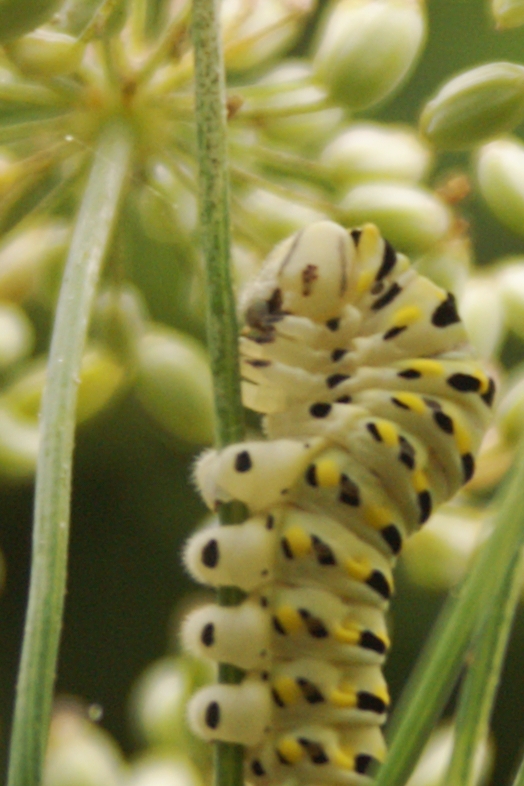
Anise swallowtail story, that took place in August 2011, ends in oddness.


A fat mature caterpillar in mid-August contemplates the choice between continuing to eat the fennel and pupation.  Eating wins out for a few more days . . . ha! notice the green stink bug on the right of this photo, recently molted!  Anyway,

eventually pupation is inevitable and the caterpillar assumes the position, spins a silk pad at the rear end and a silk safety line around the middle and waits.


Next day: the fresh pupa full of butterfly-flavored hope.

Three days later, the pupa has been split at the top (head area).
There was some brownish stuff inside.  Predation?  Parasitoid?  Mechanical accident?


The damaged pupa hung there and dried; its silk line broken.

one day I caught this bug, Creontiades rubrinervis, lurking around.  It even went inside the empty shell, seeking what?

Tuesday, December 04, 2012

Space Spider


News item in today's paper about a jumping spider that was sent to space by an Egyptian student.  Poor Nefertiti, as she was named by the student, died soon after returning from her 10 month sojourn aboard the International Space Station.  The experiment's purpose was to study the effect of low gravity on the feeding success of non-web building jumping spiders.

I was glad to read that the space travelling spider was able to adapt to the new conditions and hunt and feed during her trip, even if she had to be satisfied with fruit flies.   Article's title seems to be in error, since as stated in the last paragraph the spider will actually be added to the National Museum of Natural History's spider collection rather than residing in heaven.  Unless you believe spiders have immortal souls etc.

Another question about this story is how the Egyptian student (studying in Alexandria) came to acquire a specimen of Phidippus johnsoni, a species found in North America not Africa.  Is there international trade in jumping spiders?  Maybe he got the spider while visiting Washington DC when he won the competition.

Arachnophobes here on Earth and in space-- consider these words the next time you think about squishing a spider that has successfully navigated the ever-changing and dangerous world to reach the inner sanctum of your abode:

The Smithsonian said that the loss of Nefertiti, "a special animal that inspired so many imaginations," would be felt throughout the museum community.

Saturday, October 20, 2012

Wings


Cindy's circle of life post involving a monarch and a mantis encouraged me to get around to this:

Some monarch-eating predator (bird? rodent? mantis?) had taken the entire body of this butterfly and left the wings close together on the garden path.  That evidence itself would suggest a ground based attack rather than the butterfly being snapped out of the air mid-flight.  I gathered up the wings and held them on the expanded metal patio table for awhile; an appreciation.

On or about the same day of discovery of the wings I clipped this Lio strip from the paper:


Sometimes you acquire wings, only to get pinned to a board by someone more powerful.
Sometimes you get taken out of the game altogether.
Sometimes you get to soar wingless and unpinned in the sunlit air with rainbows and sundogs and big puffy clouds and songbirds and kites and songs and arcing arrows and helium balloons that never ever interfere with jet airplanes and zeppelins and hawks and superstars and superheroes and people with helium balloons attached to aluminum lawn chairs and dreamers and comets and all manner of other flying things.

A lot of times you sit on the sidelines watching and chronicling the ups and downs of fellow creatures.  And that's cool.

Monday, October 01, 2012

RU Ready for the Spiderz?


Yeah it's spider season.  We modern 21st century humans associate spiders with spooks, which come out of hiding in the closet (or in tupperwear containers in the attic) as the season slips around the corner toward winter, also known as the Dark Side.  It's all tied together somehow in our primordial hunter-gatherer psyche which spent its formative years hiding from man-eating predators abundantly hungry in the dark of winter, longing for the warmth of spring through the long dark spooky wolf-howl infested shadow of winter, spending long hungry dark hours in a cave or other drafty shelter, and bumping into spider webs in the darkest corners of that shelter while investigating the dim possibility of forgotten mislaid morsels of food.  We made up stories to explain how scary the dark of winter really was, I suppose.

Back to the spiders.


This is a brown widow, Latrodectus geometricus, beginning the task of wrapping her earwig prey in silk.  Later I found the completely wrapped earwig . . . at this point it was either a carcass waiting to be sucked dry by the spider or the already dry husk of an earwig.  I didn't really check.

This particular brown widow was making home out of the underside of a wooden picnic bench.  We were rude enough to upend that bench while cleaning the patio, revealing her hiding place to the sun.
Here is her exuvia, molted and cast aside awhile ago as she grew under her bench.


These spiders, introduced to California sometime around 2003 have become common in my neck of the woods over the past several years.  In fact they seem to be crowding out the black widows.  Although they are not aggressive, brown widows like their close relative the black widow have a bite that could require medical attention.  It's best to leave them unmolested.  If you're working in old wood piles, flower pots that have been unmoved for awhile and similar likely Latrodectus habitats, be on the lookout for spiders and wearing gloves might be a good idea.

Monday, August 20, 2012

Assassins in the Lace


The eriogonum giganteum, St. Catherine's lace, started blooming back in June and has lived up to the buckwheat reputation as an insect magnet.

Due to the abundance of insects visiting the blooms for nectar it's a logical and fruitful place for the assassin bugs to take up residence.  These are Zelus renardii, leafhopper assassin.  They are general predators, often seen spearing flies or a small bee with the long piercing mouthpart.  I've actually never seen one of these feeding on a leafhopper, but who am I to question the Common Name Gods?


I noticed this half grown nymph yesterday, next generation of the adult assassins shown above, taking a stroll among the fuzzy white buckwheat leaves.


The flowers are showing signs of beginning to being spent--getting a little rusty around the edges--after two months of glorious bloom.  They make good dried cut flowers, living up to the common name with an appearance strongly reminiscence of fine old handmade lace.


Sunday, March 27, 2011

Pupae Predation : (


Leaf-fattened we marched,
then outwardly quiet hung,
still.  Snap of wren's beak.

Bewick's wren is a small but mighty predator of insects.  Of the seven nymphalis antiopa pupae on the front of my house, two have survived the hunger and sharp eyes of the birds through the twelve days (so far) since pupation.

Monday, December 06, 2010

How Oleander aphids and syrphids spent their November

Toward the beginning of November these milkweeds were flushing with oleander aphids, Aphis nerii.  It's coincidental that these bright orange aphids are the same color as the flowers on this milkweed, since they also infest oleander which has white, pink or red flowers.  The aphids' bright coloration is a warning adaptation, since the aphids feed on plants toxic to many would-be predators.

There are many sizes of aphids in this established colony ranging from tiny to adult, along with some white cast off sheds.


About two weeks later I noticed some syrphid larvae mowing their way through the crowd of juicy aphids.  This one has managed to clear a significant space around itself, apparently able to tolerate the taste of these toxi-fied tidbits.  There is some documentation that ladybird and lacewing larvae suffer development problems during pupation after feeding on aphis nerii; not sure about syrphids but I'll watch and see if this one emerges whole.

Another syrphid larva stretches out along a relatively aphid-free leaf.


The first of December the syrphid larva on the stem has pupated, the crowd of aphids still keeping its distance.  A few days later, though, some aphids have begun to encroach on the pupating and now non-threatening syrphid.


Meanwhile many of the aphids on the flower buds have become alate, ready to fly off in search of unsullied fresh territory and spread the good news about being Oleander Aphids.

Saturday, October 23, 2010

We Interrupt This Afternoon for Dragonflies


Friday there was a break in the rain and cloud cover and I stepped out into the backyard to enjoy some sunshine.


I was not alone.  This huge dragonfly drifted out of the sky and landed on the schefflera not two feet from me, right in front of my sun-drenched face.  She rested there on the leaf's edge for minutes while I admired her from all angles.  She only flew off when I reached out and touched her.  When she rose into the sky I noticed that we (the dragonfly and I) were not alone.


The air was full of dragonflies, at least 10 of them flying over my property.  Why they were there soon became apparent as winged termites rained from the same airspace all around me.  Termite hatches are predictable on a sunny day after a rain, and sure enough here they were.  It's disturbing to see the large numbers of these reproductives emerging from your neighbor's roof, rising into the shining sky then fluttering onto your own sweet house made of wood.  However, the air was also full of dragonflies darting after and consuming these termites.

Birds were also feasting on the termies, notably the Black Phoebes.  A trio of them were making a ruckus fighting over the termite territory over my neighbor's roof.  Surely not all the termites get eaten, but it's good to know the dragonflies (and the birds) are on the job cutting down their numbers so our beams at least have a chance.

Thanks to Kathy Biggs for making her odonata key available online.  This big beauty that visited with me during the termite rain is a common green darner, Anax junius, female.  Common, but first time seen in my yard.

Tuesday, October 12, 2010

Assassins


Like many predator species in the garden this summer, the assassin bugs (these are Zelus renardii) have not been plentiful.  I like to think this is due to the large hunting wasp populations which may have both preyed upon these other predators and snapped up the majority of available prey.  However I have no proof except my own heresay.


Now the paper wasps (polistes apachus) were cut down 5 weeks ago, and suddenly there is an explosion of assassin bugs of various stages of development.  Coincidence?


On a recent misty morning I found a freshly molted adult.  In this picture this individual with its unhardened celadon exoskeleton forms a triad with its cast-off shed and another younger assassin bug among the angular branches and leaves of the acacia iteaphylla.