Search This Blog

Showing posts with label odonata. Show all posts

Wednesday, July 10, 2013

No Distress


So I was heading toward the back jungle to spritz a few things with water on a recent hot afternoon, when I was delighted to see a bright blue damselfly perched on a sprig of crassula pruinosa.  A tiny jade perch for a small odonata.

Damselflies are related to dragonflies, but differ in being smaller overall and damselflies hold their wings parallel above the body when at rest.

I was excited because this was a first viewing of this species on the old homestead here.  Based on photos at Natural History of OC I have concluded this must be a mature male Argia vivida, common name Vivid dancer.  I also checked out info at bugguide, and found the link to Odonata Central . . . to quote the Stephen Cresswell at bugguide:  Prepare to be amazed by this resource.  Don't fail to check out the mapping function.

This vivid dancer was accommodating as a model in the bright afternoon sunshine.  He took up several different perching positions as I snapped photos, and seemed completely non-distressed by my presence.

Saturday, June 16, 2012

Pair of Flame Skimmers . . . Almost


A mating pair of flame skimmers (Libellula saturata) flew by my head as I was moving the hose among the still-thirsty rudbeckia.  Well maybe only one of the pair was flying as is often the case when dragonflies are either in tandem (the male clasping the female behind her head and appearing to have her in tow) or mating (the female has curled the tip of her abdomen around and up to the male's "secondary sex organ" located just behind his legs).  Anyway, the heart-shaped conglomerate of this mating pair flew by then alit.  Sadly, by the time I returned with the camera they had separated.

But a male and female flame skimmer were hanging around the yard when I showed up with the camera.  Of course I can't be sure these were the mating pair:  it's also likely in the competitive world of dragonfly reproduction this is a second male that would like to mate with the same female.


The female is larger, with a thicker abdomen and of course female genitalia (ovipositor) and less brightly colored.  She is seen her resting on a steel fence post.

The male has a thinner darker colored abdomen and darker more colorful wings seen in the top photo.  In this next photo you can see the "secondary sex organ" mentioned above, which is the penis and sperm repository.


I found a lot of interesting insights into dragonfly mating behaviors in this National Geographic article.

Not sure if dragonflies are friendly, but this one gave me a facial expression that seemed jocular as I signed off.

Saturday, October 23, 2010

We Interrupt This Afternoon for Dragonflies


Friday there was a break in the rain and cloud cover and I stepped out into the backyard to enjoy some sunshine.


I was not alone.  This huge dragonfly drifted out of the sky and landed on the schefflera not two feet from me, right in front of my sun-drenched face.  She rested there on the leaf's edge for minutes while I admired her from all angles.  She only flew off when I reached out and touched her.  When she rose into the sky I noticed that we (the dragonfly and I) were not alone.


The air was full of dragonflies, at least 10 of them flying over my property.  Why they were there soon became apparent as winged termites rained from the same airspace all around me.  Termite hatches are predictable on a sunny day after a rain, and sure enough here they were.  It's disturbing to see the large numbers of these reproductives emerging from your neighbor's roof, rising into the shining sky then fluttering onto your own sweet house made of wood.  However, the air was also full of dragonflies darting after and consuming these termites.

Birds were also feasting on the termies, notably the Black Phoebes.  A trio of them were making a ruckus fighting over the termite territory over my neighbor's roof.  Surely not all the termites get eaten, but it's good to know the dragonflies (and the birds) are on the job cutting down their numbers so our beams at least have a chance.

Thanks to Kathy Biggs for making her odonata key available online.  This big beauty that visited with me during the termite rain is a common green darner, Anax junius, female.  Common, but first time seen in my yard.

Saturday, September 04, 2010

Squirrel


I bought this propeller/wind vane thingy at a yard sale one day and Mr. Cardui mounted on the fence-that-is-likely-to-fall-down-in-a-wind-someday-soon; maybe as a talisman against said misfortune, but maybe just because that was the best clear air in the back yard. There is no way he would consider putting that thing anywhere but behind the 6 foot fence. Anyway, the quirky wind vane/airplane thing looks cool but never spins either because we don't have that much wind or there is too much resistance on the rotating parts. So the other day I was walking by under it when--Squirrel!--my attention was grabbed by this dragonfly on the highest point of the highest blade.

Dragonflies favor tall posts in clear air to perch on waiting for their prey to fly by. The prop fills the bill nicely; it's tall and sticks way up there (about 8 or 9 feet). As I looked on the dragonfly captured numerous tidbits and sat on top of the prop chewing them.

Hopefully the prop won't ever spin; in that much wind the fence will surely fall and that will be the end of an ideal dragonfly perch, among other things cool and mundane.

Friday, July 02, 2010

Dragonfly Post


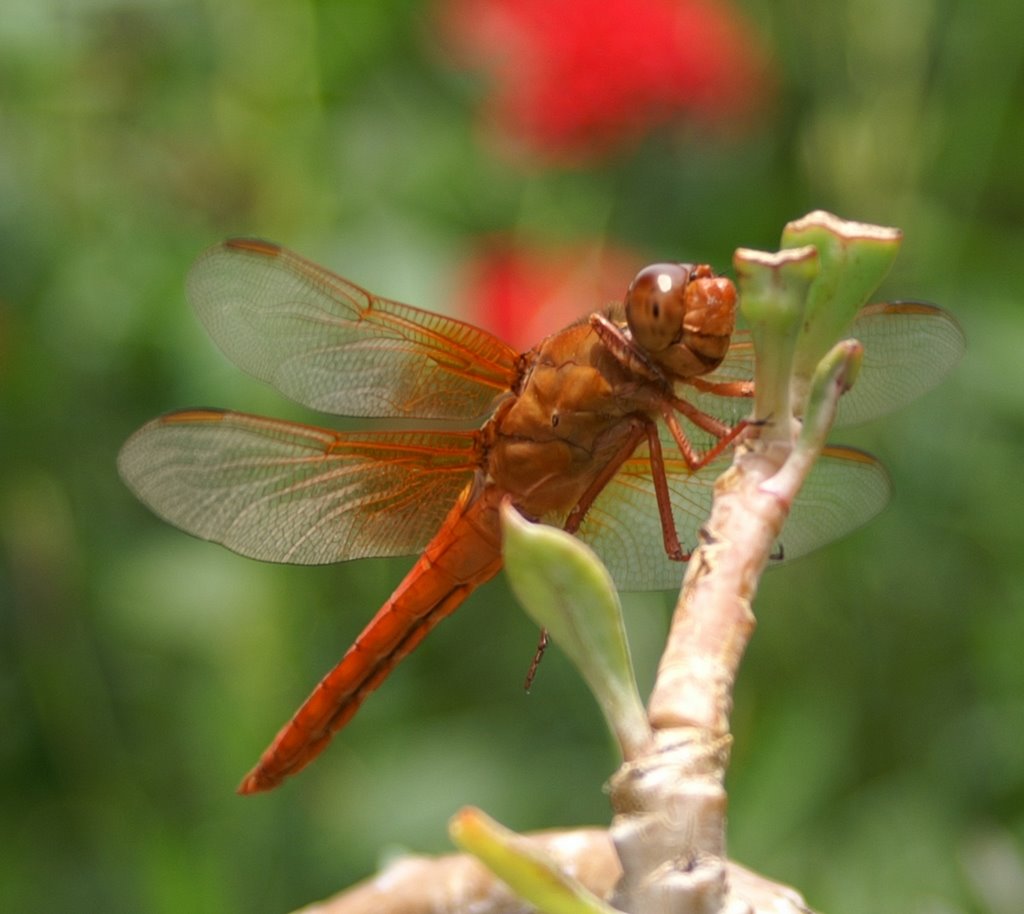
I find it hard to believe this is the first dragonfly I've seen on the estate this summer, but it is either true or I'm losing my edge. Anyway, this wire obelisk of my mom's that is just visiting in my garden seems custom made as a hunting perch for this (I believe this id is correct) female flame skimmer, Libellula saturata.

In 2009 and 2008, dragonflies were sighted in mid-May hereabouts.

Wednesday, May 13, 2009

Day Glo


So I was watering some recently planted stuff in the back when I noticed a bright streak of orange flying by close to my head. As dragonflies are likely to do, it perched on these inverted dried grass stalks at a foot or so above (my) head height of just over 5 feet. So I was able to approach quite close and watch as the dragonfly launched itself after prey overhead and returned repeatedly to the same perch to chew and pose. Eventually I got a bit too bold, putting my finger on the stalk just a few inches from it after which this dragonfly (female neon skipper, Libellula croceipennis I believe, based on the bright venation of the clear wings) took off and did not return at least as long as I was looking. I suppose she will return, since they are creatures of habit and this particular perch seemed to meet the repeated perching needs of this particular creature.


These insects are said to breed in slowly running or standing water; where that occurs in my notably dry neighborhood remains to be discovered.

5/16 update: This article reports on a survey done to assess the stability of the world's odonata (dragonflies and damselflies) species. No specifics in the piece about north American species, but an interesting comment about the lack of concrete data on insect populations and susceptibilities to extinction. A lot of jobs out there for naturalists, but who is going to pay them?

Sunday, July 13, 2008

Fly By


I watched this dragonfly (Libellula saturata) as he hunted small flying things in the garden. In about 20 minutes he caught and devoured maybe 12 or 15. It's interesting to see how he lands on his perch with such precision, always in the same attitude, then just after alighting he adjusts the angle of his body to the stick--just so with a self-assured little tug like a sailor setting a knot in the rigging or a pilot fixing the trim. You can hear the sound of the dragonfly's wings chattering--just--above the jet roaring overhead but the flies rarely sense the hunter until it's too late.

Wednesday, May 21, 2008

New Predator in Town


This flame skipper, Libellula saturata, rested on a low-growing pelargonium flower for an inordinate (unodonate?) amount of time. I like to think I'm right: that it was quite freshly emerged as an adult flyer, and needed to rest a bit before taking up the dragonfly mantle.

Thursday, August 31, 2006

Dragonfly, Gift-boxed

This very cool carved marble box decorated with dragonflies was a gift from my son. He got it in southeast asia, where he reports the real dragonflies are abundant and fly around in colorful swarms. Dragonflies are an ancient group of insects, perhaps the first to have developed the ability and equipment to fly. We honor their acheivement by flying home with odonate treasures tucked into our bag, like succulent summer prey held secure in the basket of the dragonfly's legs as it flies to its high perch.

Thursday, July 06, 2006

Still Alive


Hello, I'm still here. Very busy with life at the moment. Be back soon. Lots of great bugs out in the world right now; gotta go.